Earth Gridwork: A Practical Guide to Working With Sacred Landscapes
A practical guide to Earth gridwork, from ley lines, nodes and dowsing to sacred landscapes, ritual and responsible fieldwork.


Earth gridwork is a modern spiritual practice built around the idea that places are connected through subtle patterns of energy, meaning and relationship.
A grid worker may walk a claimed ley line, meditate at a sacred site, dowse for a possible energy node, work with maps or sacred geometry, place stones or crystals with intention, or simply spend time observing how a particular landscape feels.
Some practitioners describe this as working directly with the Earth's energetic system. Others approach gridwork more symbolically, as a way of building a conscious relationship with place.
There is no scientifically established planetary energy network that grid workers can measure, repair or rebalance. But gridwork has become a recognisable contemporary spiritual practice drawing on ley-line traditions, dowsing, geomancy, sacred geometry, pilgrimage, ritual and environmental awareness.
The most useful way to approach it is not to begin by assuming the theory is true.
Begin with the place.
Observe it carefully. Learn its history. Understand the traditions associated with it. Record what you experience. Then decide what the practice means to you.
What is Earth gridwork?
Earth gridwork is the practice of intentionally engaging with places believed to sit within, or influence, a wider network of sacred or energetic relationships.
The language varies considerably between practitioners. You may hear references to:
- ley lines
- dragon lines
- Earth grids
- energy nodes
- vortexes
- power places
- sacred geometry
- Earth chakras
- crystalline grids
- geomancy
These ideas do not describe one agreed system. Some come from twentieth-century Earth Mysteries. Some draw inspiration from older traditions of geomancy and sacred landscape. Others belong to much more recent New Age spiritual practice.
What connects them is the belief, or working hypothesis, that place matters in ways that go beyond simple geography.
Gridwork is what happens when someone attempts to engage deliberately with that possibility.
Is Earth gridwork the same as ley-line hunting?
Not quite.
Ley-line hunting generally focuses on identifying possible alignments between significant landscape features. You might study maps, plot churches, standing stones, wells and hilltops, then investigate whether several locations form a meaningful straight line.
Gridwork begins where that mapping exercise ends.
A practitioner might believe that a line or node can be sensed, worked with, honoured, strengthened or symbolically connected to other places. The practice can involve meditation, dowsing, walking, ritual, sound, sacred geometry or intention.
That means ley lines can form part of gridwork, but Earth gridwork is a much broader spiritual practice.
If you are new to the subject, start with What Are Ley Lines? and How to Find Ley Lines Near You before assuming that a mapped alignment is an energetic pathway.
Where did the idea come from?
There is no single historical origin for Earth gridwork as it is practised today.
Modern gridwork combines several streams of thought.
Alfred Watkins' 1920s ley-line theory introduced the idea that significant places in the British landscape might form long alignments. Later Earth Mysteries writers transformed ley lines from proposed ancient trackways into possible currents of Earth energy.
Dowsers added techniques for sensing unseen lines and underground features. Sacred-geometry writers proposed larger geometric patterns across landscapes and, eventually, the globe. New Age spirituality added concepts such as Earth chakras, energetic healing, crystal grids and planetary consciousness.
At the same time, older traditions from many cultures have long treated particular places, routes, mountains, springs and directions as sacred.
Those older traditions should not simply be renamed "gridwork".
Modern Earth gridwork borrows ideas from them, but it is largely a contemporary synthesis.
What does an Earth gridworker actually do?
There is no standard gridwork procedure.
Some practitioners undertake elaborate ceremonies. Others simply walk, observe and meditate.
Common approaches include:
- mapping possible ley lines or significant sites
- visiting claimed nodes or vortexes
- dowsing with rods or pendulums
- meditating at sacred places
- using sacred geometry as a focus for ritual
- placing temporary arrangements of stones or crystals
- using sound, prayer or intention
- walking a route as a pilgrimage
- recording bodily sensations, dreams or synchronicities
- revisiting the same place over time
At its best, gridwork can become a disciplined form of attention. At its weakest, it can become a system in which every sensation confirms the original belief.
The difference is methodology.
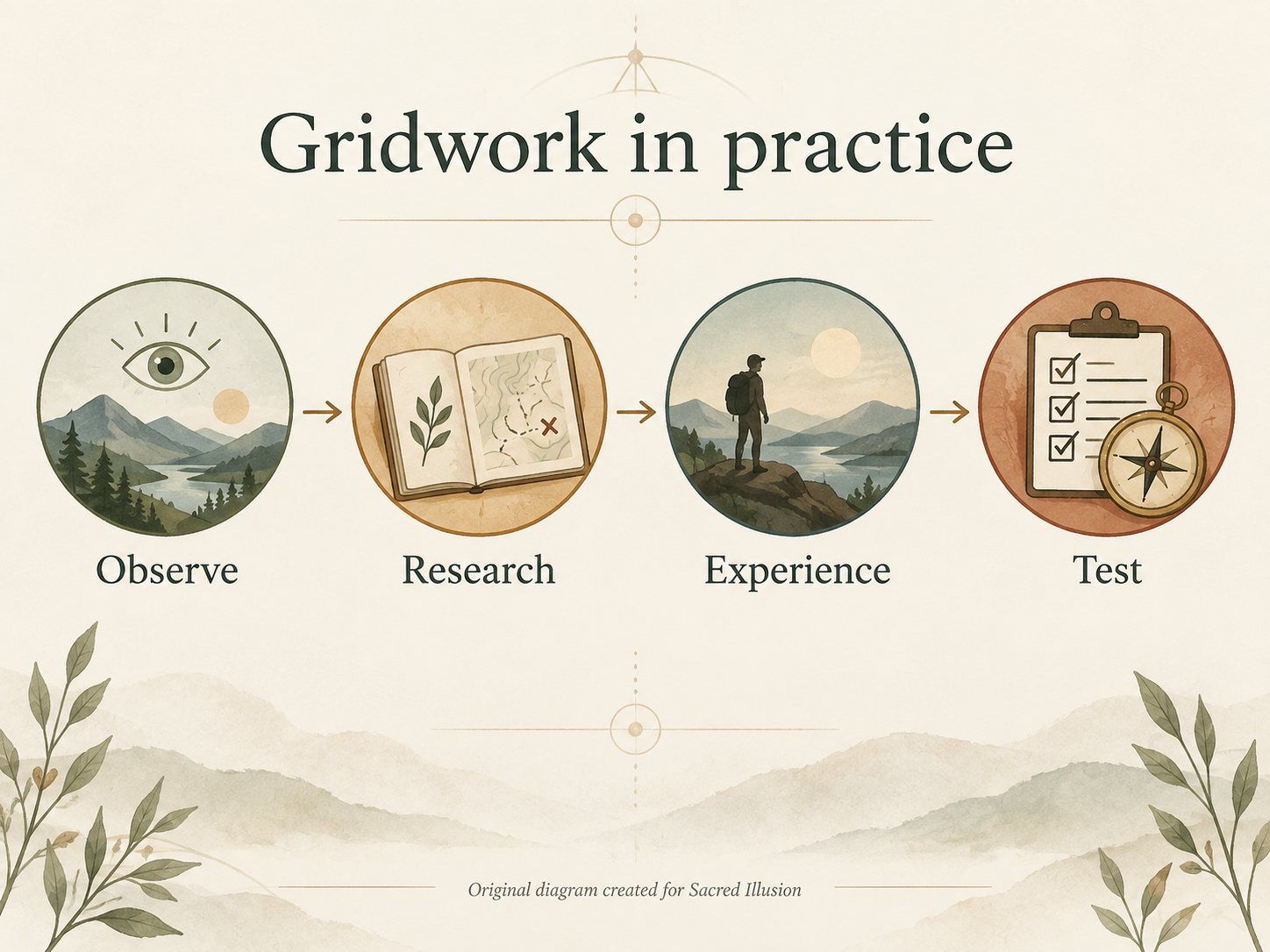
Step 1: begin with the landscape
Before trying to sense anything invisible, understand what is visible.
Look at the terrain.
- Where is the high ground?
- Where does water move?
- What can be seen from the site?
- Are there ancient tracks, paths or boundaries?
- What is the geology?
- How has the landscape changed?
A hilltop church, spring or stone circle may have become significant for very practical reasons as well as spiritual ones. Knowing those reasons does not strip a place of mystery. It gives the mystery context.
Step 2: research the history
Find out what the place actually is.
Historic Environment Records, archaeological databases, old maps, local archives and reliable histories can reveal whether a site is prehistoric, medieval, modern or a mixture of several periods.
Ask:
- When was the site first used?
- Was something there previously?
- Was it connected to a route or settlement?
- Did pilgrimage take place there?
- Is there evidence of ritual use?
- What folklore is genuinely old and what appeared recently?
This can prevent an easy mistake in gridwork: treating every attractive modern story about a place as ancient tradition.
Sometimes the historical story will be stranger and richer than the spiritual claim.
Step 3: separate tradition from observation
Once you know the physical and historical site, look at the spiritual traditions associated with it.
Perhaps dowsers claim two lines intersect there. Perhaps a spring has healing folklore. Perhaps modern practitioners describe it as a vortex. Perhaps an Earth-chakra map includes it. Record those claims as tradition or interpretation.
Then visit the place without turning those claims automatically into facts.
This distinction is one of the most useful habits in Sacred Illusion fieldwork:
What is here? What is known about it? What do people claim about it? What did I personally experience?
Those four questions do not need to produce the same answer.
Step 4: observe before doing anything
Gridwork is often described as intervention: clearing, activating, healing or stabilising a place.
I would reverse the order.
- Spend time observing first.
- Sit (or stand) quietly.
- Walk the site.
- Notice sound, weather, temperature, sightlines, animals, people, infrastructure and your own physical state.
- If you experience something unusual, record it.
- Do not immediately label it.
A sensation of pressure might be meaningful to you. It may also be fatigue, altitude, heat, anxiety or expectation.
An EMF reading may be unusual. It may also reflect electrical infrastructure or your device.
Observation becomes much more useful when explanation comes later.
Step 5: map what you find
A simple field notebook is one of the best gridwork tools.
Record:
- date and time
- weather
- location or coordinates
- route walked
- visible landscape features
- historical information
- claimed ley lines or nodes
- instrument readings, if used
- dowsing responses
- bodily sensations
- emotional state
- unusual events
- questions raised
- what you would test on a return visit
Maps are useful too.
Plot the places you visit. Add possible lines only after you have selected the significant points. Compare your own observations with published grid maps rather than assuming somebody else's map is authoritative.
Repeated visits are particularly valuable.
A place experienced once during sunset, after a difficult journey and with strong expectations may feel completely different on a cold ordinary Tuesday morning.
That difference is information.
Using dowsing in gridwork
Dowsing rods and pendulums are among the tools most closely associated with Earth gridwork.
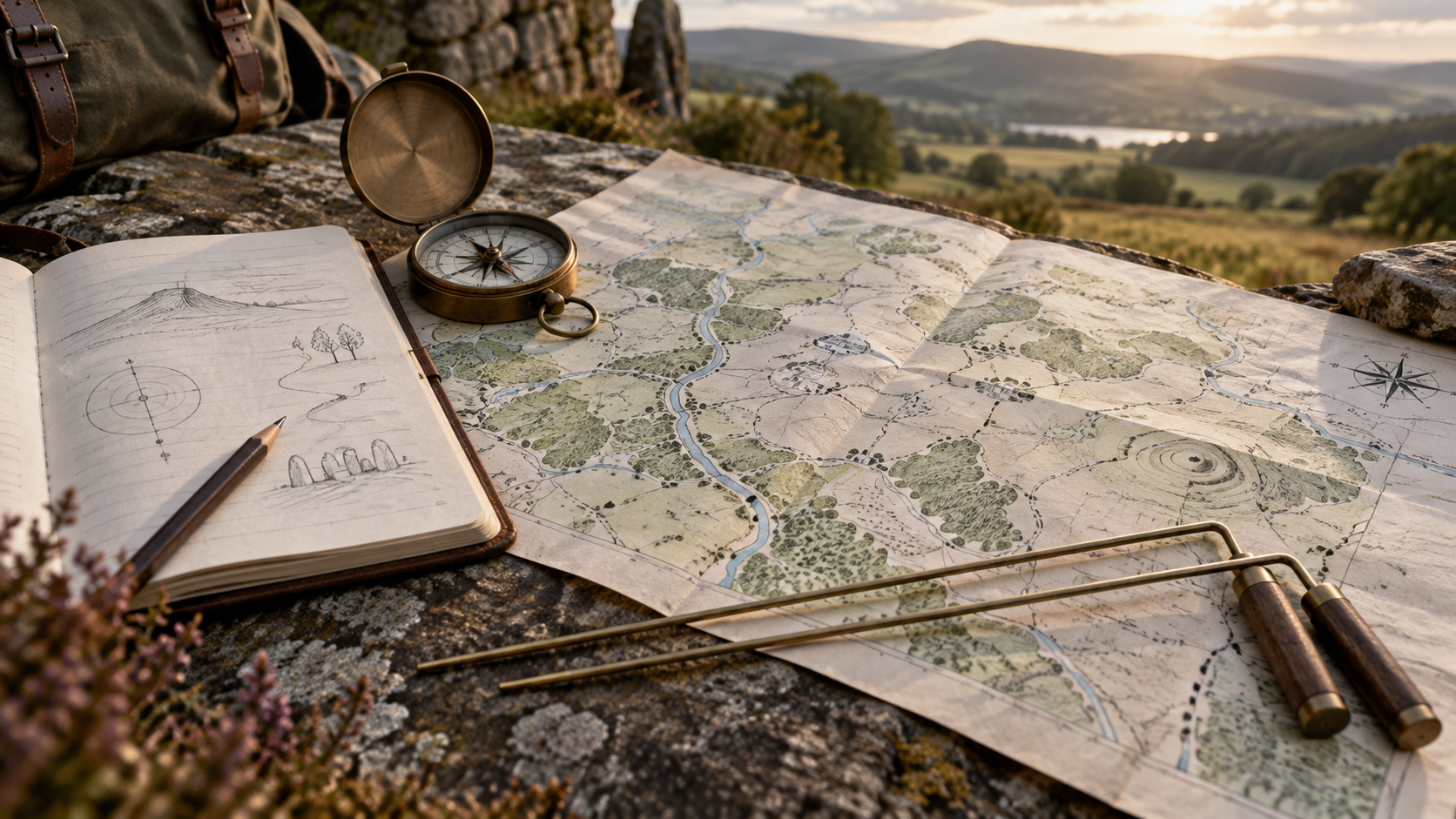
Practitioners may use them to trace claimed lines, locate nodes or test different areas of a site.
If you choose to use dowsing, make the experiment more disciplined.
Decide beforehand what response you are looking for. Walk the same route several times. Approach from different directions. Mark the location without changing it after the fact.
Better still, ask another person to test the area without telling them what you found.
Controlled scientific research has not established dowsing as a reliable detector of invisible Earth-energy lines. Rod and pendulum movements can be influenced by the ideomotor effect, where unconscious muscular movements produce visible motion.
That does not prevent you using dowsing as an exploratory or spiritual practice.
It simply changes what the result can prove.
Using compasses, EMF meters and other instruments
Modern gridwork sometimes incorporates technological tools.
You may see practitioners using:
- compasses
- magnetometers
- EMF meters
- GPS devices
- phone sensors
- sound meters
- temperature sensors
These instruments measure real physical phenomena.
That can make them useful.
It can also create false confidence.
An EMF meter can identify electromagnetic fields. It cannot tell you whether those fields represent a spiritual energy node.
A compass responds to magnetism. Local metal, vehicles, power infrastructure and geology can affect readings.
A magnetometer detects magnetic variation. A variation is not automatically evidence of a ley line.
Use instruments to record what they genuinely measure, then investigate possible explanations.
Do not ask the instrument to answer a metaphysical question it was never designed to answer.
What is an energy node?
Within Earth-grid belief, a node is a location where several energetic pathways are thought to intersect.
Practitioners often describe nodes as places of concentrated energy.
Some are associated with ancient monuments or sacred buildings. Others are identified primarily through dowsing or subjective experience.
The concept is useful as a gridwork hypothesis.
If you believe you have found a node, ask what makes the location distinctive.
Is it a crossing of ancient routes? A spring? A geological transition? A prominent hill? A place with a long ritual history? A modern electrical source? Or is the significance primarily experiential?
We will explore that question more deeply in How to Recognise an Energy Node.
What is a vortex?
Vortexes are usually described as places where energy moves in a spiral rather than along a line.
They are particularly prominent in contemporary spiritual traditions surrounding places such as Sedona.
A vortex is not a scientifically recognised category of geophysical feature.
The term belongs primarily to spiritual and experiential interpretations of landscape.
Some people report powerful effects at claimed vortex sites. Those experiences are worth documenting carefully, particularly when independent visitors describe similar sensations.
But a shared experience and a demonstrated physical mechanism remain different things.
Sacred geometry in gridwork
Sacred geometry often appears in gridwork as both an interpretive framework and a ritual tool.
Some practitioners draw triangles, circles or other geometric relationships between sacred places. Others arrange stones, crystals or symbolic objects in spirals, hexagons, interlocking triangles or patterns such as the Flower of Life. In that sense, geometry can give ritual structure, focus and symbolic meaning to the work.
It is important, though, to separate using geometry symbolically from claiming that a geometric pattern proves the existence of a measurable Earth-energy system.
Geometric patterns can emerge from almost any sufficiently large collection of points, especially when the points are selected after the pattern is noticed. If you are projecting geometry over a landscape, record your selection rules beforehand and test whether the same pattern still appears when alternative sites are included.
The stronger the claimed pattern, the more important that discipline becomes.
Sacred Illusion treats sacred geometry in gridwork primarily as ritual and symbolic practice: a way of organising place, attention and intention. That does not demonstrate that the geometry itself alters a measurable Earth-energy field.
Sacred geometry has a much larger history and meaning beyond gridwork, so we explore the wider subject separately in our Symbols & Energy collection.
Crystals and temporary grids
Crystal grids are another common part of contemporary gridwork.
Practitioners arrange stones in geometric patterns and use them as a focus for meditation, prayer or intention.
There is no scientific evidence that crystals placed in a pattern alter a planetary energy network.
They may still function meaningfully within ritual.
A physical arrangement can focus attention. Objects can carry personal symbolism. Building something deliberately can change how we engage psychologically and spiritually with a place.
If you use crystals or other objects outdoors, leave no trace.
Do not bury crystals, push objects into ancient monuments or leave offerings that become litter.
Sacred practice does not override conservation.
Does a grid need to be "healed" or "repaired"?
This is one of the claims in modern gridwork that deserves particular care.
Some practitioners believe Earth-energy lines can become blocked or damaged through construction, conflict, environmental destruction or traumatic events.
Gridwork rituals may therefore be described as healing, clearing, repairing or stabilising the grid.
There is currently no scientific evidence that a subtle planetary energy network can be damaged and repaired in this way.
There is, however, a more grounded interpretation of the practice. Places genuinely can be damaged. Habitats can be destroyed. Watercourses can be polluted. Sacred sites can be neglected. Communities can experience violence and loss. Landscapes can carry difficult histories.
A ritual intended to heal a place may therefore have symbolic, personal or communal meaning even without demonstrating an invisible energetic repair.
And sometimes the most useful form of Earth work is extremely physical: picking up litter, supporting conservation, protecting access, learning the history or helping restore an actual landscape.
Intention and ritual
Intention sits at the centre of most gridwork practice. A practitioner may enter a landscape with a particular purpose: gratitude, healing, reconciliation, connection or simply attention.
Ritual can make that intention tangible. It might involve walking a particular route, sitting silently, singing, praying, drawing a temporary geometric form or meditating at several linked sites.
There is no need to claim that intention physically reprograms the planet in order for ritual to matter.
Human beings have used ritual to organise attention, meaning and relationship for thousands of years.
If gridwork makes someone look more closely at the land, behave more respectfully within it and develop a deeper sense of responsibility towards place, something meaningful has already happened.
Gridwork and simulation theory
Sacred Illusion also explores simulation theory, so there is an obvious temptation to imagine the Earth grid as part of reality's hidden code.
There is currently no reason to believe that planetary grid theories reveal the programming architecture of a simulated universe.
But simulation theory can still provide a provocative philosophical lens.
If reality were information-based, what would place mean?
Would some locations matter more than others?
Could consciousness interact with a system differently under different conditions?
Those are legitimate speculative questions.
The mistake is turning a metaphor into a mechanism simply because the metaphor is attractive.
A Sacred Illusion approach to gridwork
My preferred way to explore gridwork is deliberately simple.
Use four layers:
- Place- What is physically here?
- History - What can reliable sources tell us about the site?
- Tradition- What spiritual, folkloric or esoteric claims are associated with it?
- Experience - What do you actually notice?
Then add a fifth:
- Test- What could you do differently next time to challenge your interpretation?
That might mean visiting at another time of day, taking a control reading elsewhere, asking another person independently, or researching something you noticed after returning home.
This method does not demand belief or disbelief.
It creates better questions.
That is the spirit behind Sacred Illusion's future Node Quests.
Becoming a gridworker
You do not need special initiation, expensive equipment or claims of supernatural sensitivity to begin exploring gridwork.
Start locally. Choose one landscape you can return to. Learn it slowly.
Read its history. Walk its paths. Understand its water, geology and old sites. Notice how it changes with weather and season.
If you use dowsing or meditation, record the results. If you make a prediction, write it down before testing it. If you feel something unusual, resist the urge to explain it immediately. And if nothing unusual happens, write that down too.
The goal is not to become someone who finds energy everywhere. The goal is to become someone who notices more.
Ethical gridwork
Any practice involving sacred landscapes needs boundaries.
Respect private land. Stay on permitted paths. Follow restrictions around protected archaeological sites. Do not remove stones or artefacts. Do not bury objects.
Do not leave crystals, candles, ribbons, coins or other offerings where they may damage a site or become litter.
Be particularly careful when engaging with sacred places belonging to living religious or Indigenous communities.
A place is not a spiritual playground simply because it feels powerful to a visitor.
Curiosity and reverence should increase respect, not reduce it.
So, does Earth gridwork work?
That depends upon what "work" means.
If the claim is that gridwork has been scientifically demonstrated to repair an invisible planetary energy network, the answer is no.
If the question is whether practitioners genuinely experience particular landscapes as meaningful, powerful or transformative, clearly many do.
If gridwork encourages closer observation, historical research, pilgrimage, ritual, environmental care or a more conscious relationship with place, those outcomes are real even if the metaphysical explanation remains uncertain.
The more interesting approach may be to hold both possibilities at once.
Perhaps some of the old and modern energy theories will eventually prove to describe phenomena we do not yet understand.
Perhaps many of them are symbolic systems through which humans express a much older truth: we are not separate from the landscapes we inhabit.
Either way, Earth gridwork becomes more interesting when it begins with attention rather than certainty.
Frequently asked questions
What is Earth gridwork?
Earth gridwork is a modern spiritual practice involving intentional engagement with ley lines, sacred sites, claimed energy nodes, vortexes and other patterns in the landscape. Practices may include mapping, meditation, dowsing, ritual and field observation.
Is Earth gridwork scientifically proven?
No. Science has not demonstrated the existence of a planetary subtle-energy grid that can be repaired, activated or stabilised through ritual. Gridwork is best understood as a spiritual and experiential practice.
Do I need dowsing rods to practise gridwork?
No. You can explore gridwork using maps, historical research, walking, observation, meditation and journalling. Dowsing is one optional practice.
Can EMF meters detect Earth energy?
EMF meters detect electromagnetic fields. They cannot establish whether an electromagnetic reading represents a ley line, node or spiritual energy field.
What is the difference between gridwork and a crystal grid?
Earth gridwork deals primarily with places and proposed landscape networks. A crystal grid is a deliberate arrangement of crystals, usually in a geometric pattern, used as a focus for intention or ritual. Crystal grids may form part of some Earth-grid practices.
Can gridwork heal the Earth?
There is no scientific evidence that ritual can repair a subtle planetary grid. Gridwork may nevertheless have symbolic or spiritual meaning, and it can inspire tangible environmental care.
Where should a beginner start?
Choose one accessible local place. Research its history, map its landscape features, visit it repeatedly and keep detailed notes. Begin by observing rather than attempting to "activate" or change anything.
Continue exploring
The Earth's Energy Grid: Theories, Maps and the Search for a Hidden Network
Explore the larger theories behind planetary grids, ley lines, nodes and sacred geometry.
What Are Ley Lines? History, Evidence and the Mystery of the Old Straight Track
Discover how Alfred Watkins' idea of ancient landscape alignments developed into modern Earth-energy beliefs.
How to Find Ley Lines Near You: Maps, Methods and Fieldwork
A practical guide to mapping and testing possible alignments in your own landscape.
How to Recognise an Energy Node
Explore what practitioners mean by a node and how to investigate one carefully.
Sacred Earth
Explore sacred places, pilgrimage, landscape mysteries and future Node Quests.