What Is an Energy Vortex? The Anatomy of a Sacred Power Place
What is an energy vortex? Explore Sedona's vortex traditions, reported sensations, magnetic anomalies and the mystery of powerful places.

Some places are described as still. Others are described as charged. And then there are places people describe as moving.
A vortex, in modern spiritual language, is usually understood as a place where energy is believed to spiral, flow or concentrate in a distinctive way. Visitors may report tingling, emotional release, unusual calm, heightened awareness, a sense of being pulled inward or pushed outward, or simply the feeling that the atmosphere is different.
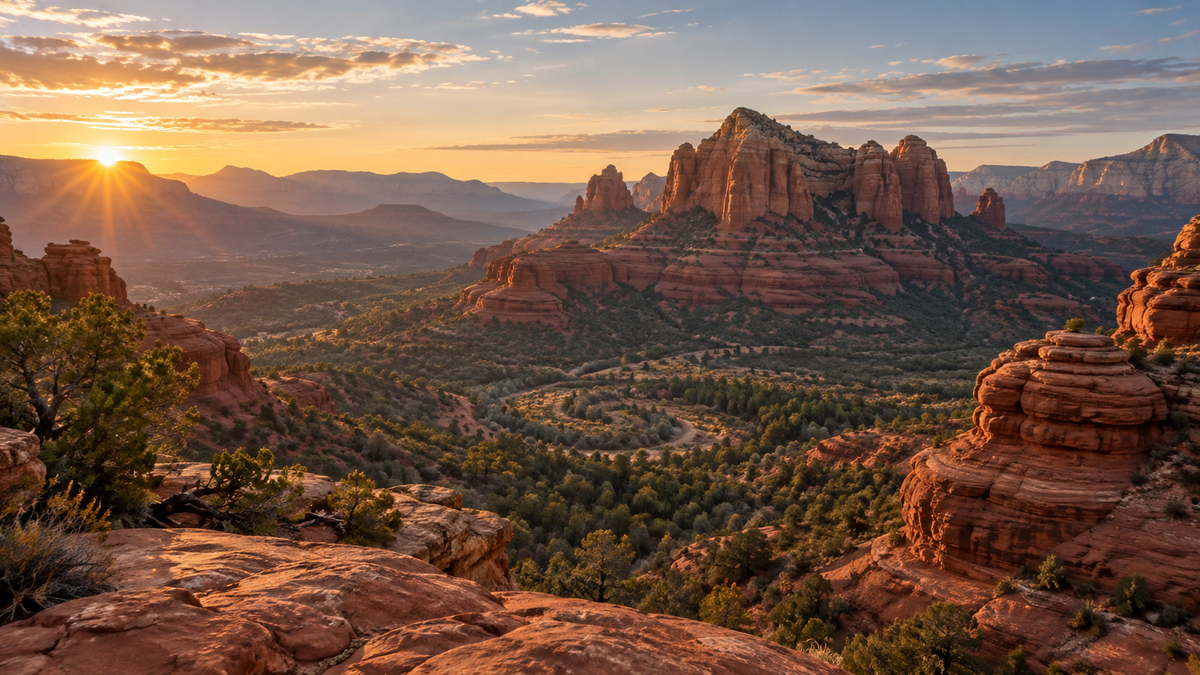
Sedona is the best-known modern example. Its red-rock landscapes are now associated with named vortex sites where people meditate, hike, pray and seek spiritual experiences.
But what exactly is an energy vortex? Is it a measurable physical phenomenon, a spiritual interpretation of landscape, a modern sacred-geography tradition, or a name we give to places that affect consciousness in ways we do not fully understand?
The most useful answer is that a vortex is a spiritual and experiential category, not a scientifically established geophysical one. That does not make the idea uninteresting. It makes it something worth investigating carefully.
What do people mean by an energy vortex?
In contemporary spiritual practice, an energy vortex is a location believed to contain unusually concentrated, moving or spiralling subtle energy.
Practitioners often describe vortexes as places where the relationship between person and landscape feels intensified. Meditation may feel deeper, emotions may surface more quickly, time may feel strange, decisions may seem clearer, and some people describe a sense of connection to something larger than themselves.
The language varies considerably. You may hear vortexes described as:
- spiralling centres of Earth energy
- places where the veil feels thin
- gateways or portals
- areas of heightened consciousness
- power places
- sacred centres
- points where energy enters or leaves the Earth
These are interpretations, not established scientific descriptions. The experience may be very real to the person having it. The explanation remains open.
Energy node, vortex or magnetic anomaly?
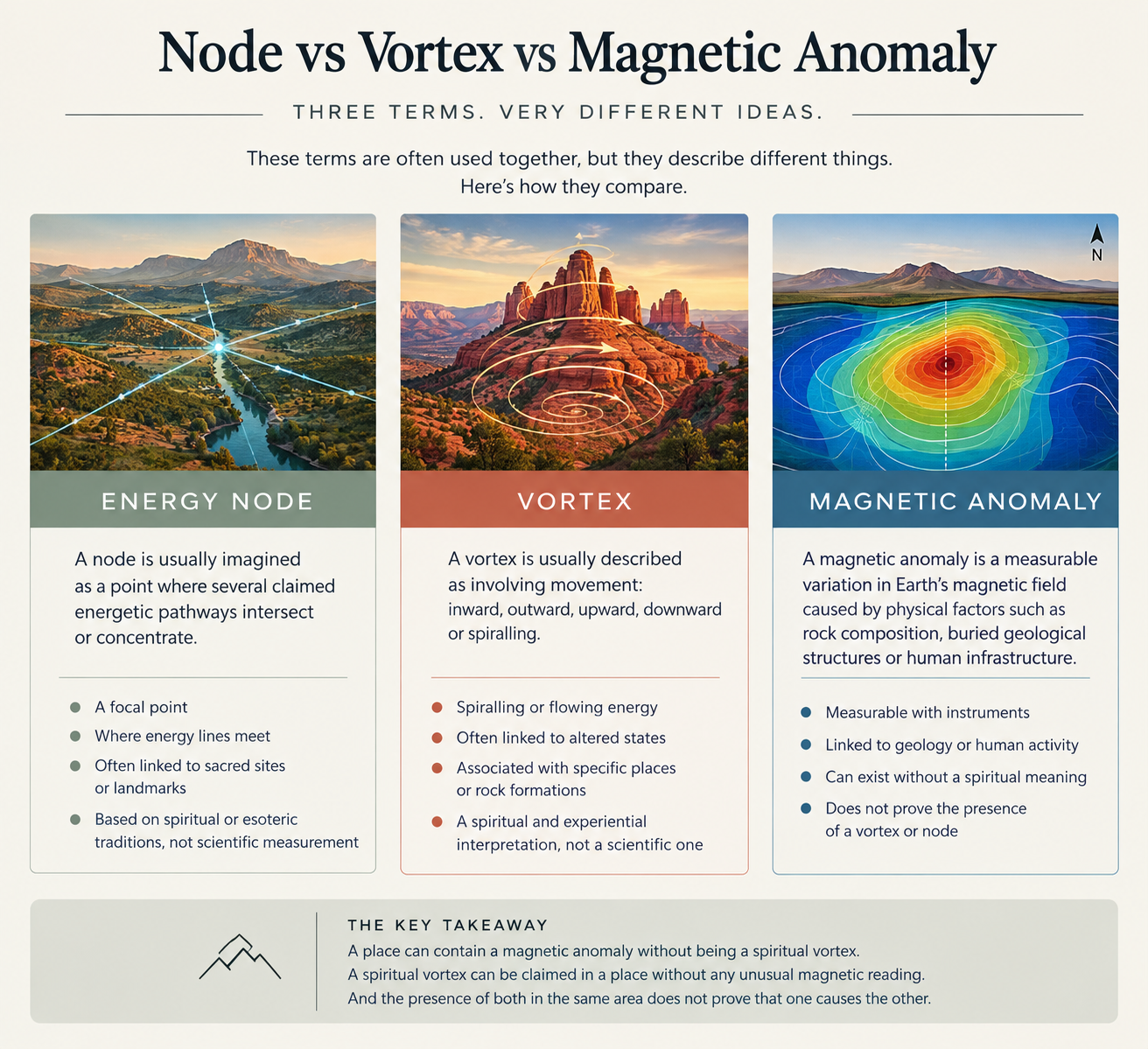
These terms are often bundled together, but they are not the same thing.
Energy node
A node is usually imagined as a point where several claimed energetic pathways intersect or concentrate.
Vortex
A vortex is usually described as involving movement: inward, outward, upward, downward or spiralling.
Magnetic anomaly
A magnetic anomaly is a measurable variation in Earth's magnetic field caused by physical factors such as rock composition, buried geological structures or human infrastructure.
That last category is important because it gives us something objectively measurable. A place can contain a magnetic anomaly without being a spiritual vortex, while a spiritual vortex can be claimed in a place without any unusual magnetic reading.
The presence of both in the same area does not prove that one causes the other.
Why Sedona became synonymous with vortexes
No modern place is more closely associated with vortex culture than Sedona, Arizona.
Its dramatic red-rock landscape had long been spiritually significant to Indigenous peoples and later attracted artists, seekers and alternative spiritual communities. The modern language of named Sedona vortexes appears to have developed particularly during the late twentieth century.
The Sedona Chamber of Commerce traces the modern vortex concept in the area to Page Bryant, who identified and described specific energy centres around 1980. Today the idea is embedded deeply in Sedona's spiritual tourism, with sites such as Bell Rock, Cathedral Rock, Airport Mesa and Boynton Canyon routinely described as vortex locations.
Modern Sedona literature usually divides vortexes into several energetic types. That classification is part of a living spiritual tradition. It is not a geophysical classification.
Upflow, inflow and balanced vortexes
Sedona's vortex tradition commonly uses three categories.
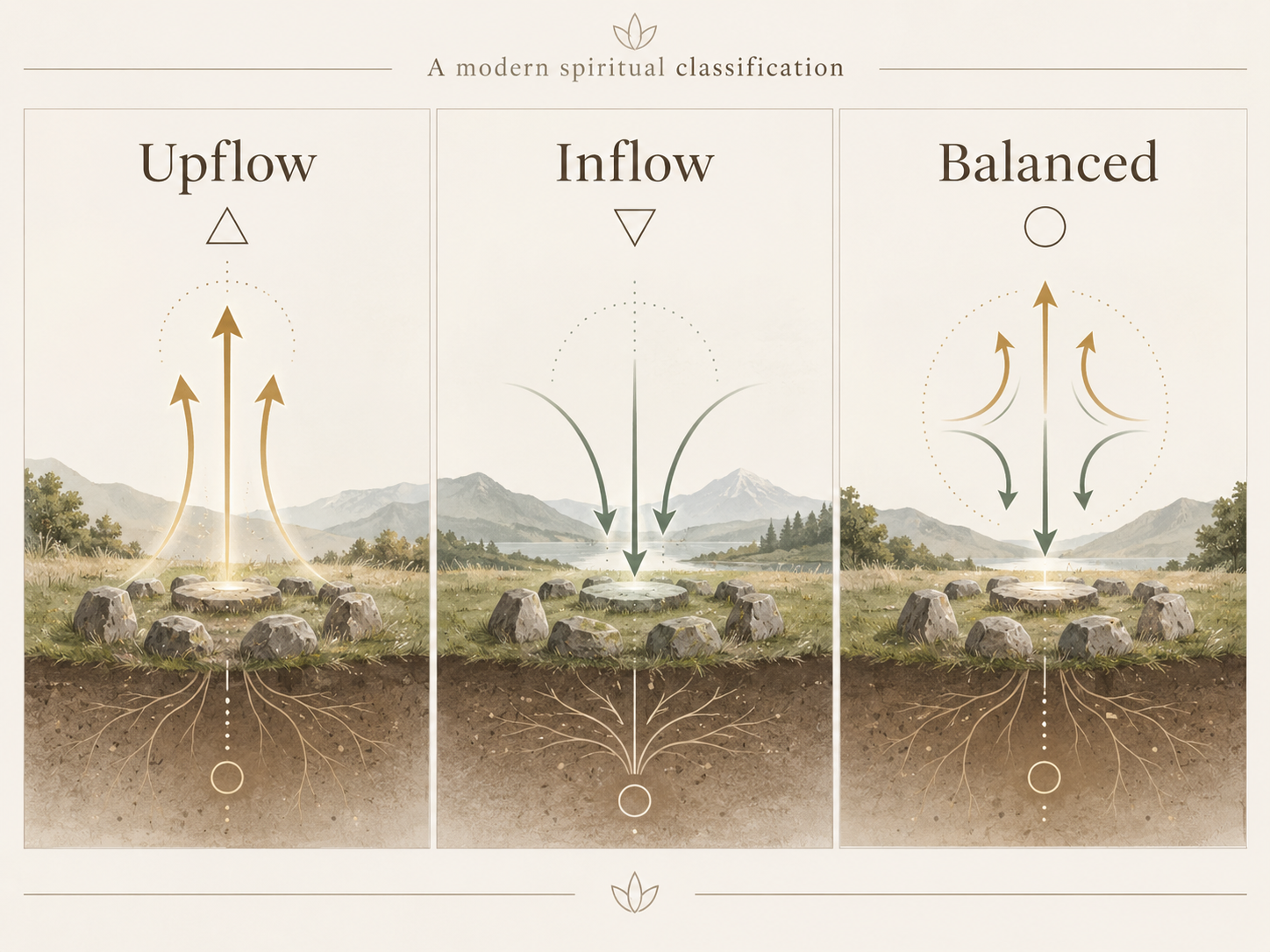
Upflow vortexes
Sometimes called masculine, electric or outward vortexes, these are said to direct energy upward and outward. Practitioners associate them with:
- motivation
- clarity
- confidence
- expanded perspective
- energetic intensity
- heightened meditation
Bell Rock is commonly described in this way.
Inflow vortexes
Sometimes called feminine, magnetic or inward vortexes, these are said to draw energy inward. Practitioners associate them with:
- reflection
- stillness
- emotional release
- healing
- introspection
- grounding
Cathedral Rock is often described as an inflow or feminine vortex.
Balanced vortexes
Some locations are described as combining both qualities. Boynton Canyon is one example frequently identified in this category.
These labels can be useful within spiritual practice because they give people a language for comparing experiences. But they should not be confused with measurable electric or magnetic fields simply because the same words are used.
“Magnetic” in spiritual vortex language does not necessarily mean magnetic in the geophysical sense.
What do people report feeling at vortex sites?
Accounts vary enormously. Some visitors report physical sensations such as:
- tingling
- warmth
- pressure
- goosebumps
- light-headedness
- heaviness
- changes in breathing
- a sense of movement or vibration
Others describe emotional or psychological effects such as deep calm, unexpected tears, clarity, euphoria, heightened attention, vivid dreams, a sense of connection or synchronicities after visiting.
And many people feel nothing unusual at all.
That last point matters. A place does not stop being beautiful, culturally important or spiritually meaningful because it fails to deliver an extraordinary sensation on demand.
What else might explain the experience?
There are plenty of possible explanations that do not require a hidden energetic mechanism.
Landscape
Dramatic landscapes alter attention. Cliffs, open horizons, enclosed canyons and vast views can create awe, stillness or emotional intensity.
Physical exertion
Many vortex sites require walking or climbing. Changes in breathing, heart rate, temperature and balance can produce sensations that are easy to interpret spiritually.
Expectation
If you arrive expecting a place to feel powerful, you are more likely to notice unusual sensations. That does not make the experience false. It means expectation is part of the experience.
Social suggestion
If guides, books and other visitors tell you that a particular rock formation is an intense vortex, your attention may sharpen around that idea.
Ritual
Meditation, silence, intention-setting and focused breathing can alter consciousness anywhere. At an already dramatic sacred landscape, that effect may feel particularly strong.
Memory and meaning
A place can affect you because of what it represents. Pilgrimage, grief, myth, identity and personal history all change how landscapes are experienced.
The interesting point is that several of these factors can operate together.
What about magnetism?
Sedona makes this question particularly tempting because real magnetic anomalies exist in the wider region.
US Geological Survey work has mapped magnetic highs around Sedona and attributes them to buried geological structures, including Precambrian crystalline basement beneath younger sedimentary rocks.
That is genuine geophysics. It does not establish that Sedona's named spiritual vortexes correspond to those anomalies.
This is exactly the sort of distinction Sacred Illusion wants to preserve. A physical anomaly may be interesting in its own right, while a spiritual vortex may be meaningful in its own right. One should not be used automatically to prove the other.
Do twisted trees prove vortex energy?
One popular piece of Sedona vortex folklore concerns trees with twisted trunks and branches. Some guides point to spiralling junipers as visible evidence of vortex energy.
The trees are certainly striking, but twisted growth can have many ordinary causes, including wind exposure, slope, damage, uneven growth conditions and environmental stress.
The fact that a tree resembles a spiral does not demonstrate that it has been shaped by subtle energy. Still, the image is powerful because it reinforces the vortex story, making the landscape appear to echo the idea of rotation.
That relationship between symbol and place is part of what makes vortex culture compelling.
Does the spiral itself matter?
This is where we can allow ourselves a little woo.
Spirals appear everywhere: in shells, storms, whirlpools, galaxies, plant growth, ancient carvings and labyrinths. The spiral is one of humanity's oldest and most persistent symbols, often representing movement, transformation, birth, death, return, descent and emergence.
So it is not surprising that spiritual traditions use the spiral to describe places of transition or intensified experience. The symbol fits the feeling.
That does not mean every natural spiral is evidence of a hidden Earth-energy field, but it may explain why vortex language feels intuitively right to so many people.
Sometimes a symbol persists because it describes something psychologically before it describes anything physically.
Can vortexes affect consciousness?
People certainly report altered states of consciousness at vortex sites. The harder question is why.
Meditation, landscape, awe, ritual, expectation, exertion and emotional intensity can all change consciousness. There is no established scientific evidence that a spiritual vortex directly alters the brain through a distinct hidden field.
But the absence of a demonstrated mechanism does not erase the experience. If someone has a profound insight at Cathedral Rock, the experience happened.
The responsible question is not “Did the vortex definitely cause it?” It is “What conditions came together to make this experience possible?”
That is a much richer question.
Are vortexes ancient?
Not always.
This is another place where modern spiritual writing often blurs history. Some landscapes now described as vortexes have ancient sacred traditions, but that does not necessarily mean the people who regarded them as sacred understood them using the modern term “vortex”.
The word often belongs to a contemporary framework layered onto older sacred places. That layering matters.
It is possible to respect the ancient cultural meaning of a place without retroactively forcing modern New Age language onto it.
What about Indigenous traditions?
This needs particular care.
Many places now marketed as vortex destinations exist within landscapes that have long-standing Indigenous cultural and spiritual significance. Those traditions should not be reduced to evidence for modern vortex theory.
A sacred mountain, canyon or spring may hold meaning within a specific living culture that has nothing to do with modern ideas of ley lines, chakras or spiritual energy tourism.
If you visit such places, learn whose land you are on and how the site is understood locally. Mystery should deepen respect, not flatten different traditions into one universal system.
How to investigate a vortex for yourself
If you visit a claimed vortex, do not begin by asking whether you believe in it. Begin by observing.
Before you arrive
Write down what you already know. What are you expecting? What have other people told you? How do you feel physically and emotionally?
At the site
Notice the obvious first: landscape, wind, temperature, sound, altitude, crowds, sunlight, smell, your breathing and your body. Then record anything unusual.
Separate experience from interpretation
Write:
“I felt pressure in my chest.”
before writing:
“The vortex opened my heart chakra.”
The first is observation. The second is interpretation. Both can belong in your journal, but they belong in different columns.
Move around
Does the sensation change 20 metres away? 100 metres away? At another nearby location?
This matters because a vortex is usually described as a specific energetic zone.
Return if you can
Visit in different weather, at a different time of day, or when you are in a different emotional state. Repeated experience is more informative than one dramatic moment.
What if you feel nothing?
Then nothing happened. That is useful information.
You do not need to manufacture a mystical experience because a guidebook told you the place is powerful. Maybe the location is not meaningful to you, maybe your attention is elsewhere, maybe the vortex idea is wrong, or maybe you need to return.
Or maybe extraordinary landscapes do not owe us extraordinary experiences.
That possibility deserves more respect than it usually gets.
Can a vortex be dangerous?
Not in the supernatural sense that some online material implies.
There is no established evidence that spiritual vortexes physically harm people through subtle energy. The real risks are much more ordinary: heat, altitude, dehydration, difficult terrain, getting lost, or pushing yourself because you believe a mystical experience should happen at a particular spot.
If a place makes you dizzy, disoriented or unwell, treat that first as a physical safety issue. Mystery is not a substitute for common sense.
Vortexes and personal transformation
This is probably where the idea has its strongest value.
A person travels deliberately to a powerful landscape. They leave ordinary routines behind, walk, become quiet, pay attention, enter the place with intention, reflect, and notice their own thoughts and emotions differently.
Whether or not an external subtle-energy field exists, that combination can be transformative.
The vortex may be physical, symbolic, psychological, spiritual, or some combination we do not yet have good language for.
That uncertainty is not a weakness. It is the interesting part.
So, what is an energy vortex?
The most accurate answer is this:
An energy vortex is a place believed within modern spiritual traditions to contain unusually concentrated, directional or spiralling subtle energy.
People report powerful experiences at some of these locations, but there is no scientifically accepted instrument that can identify a spiritual vortex as a distinct physical phenomenon. Some vortex landscapes also contain real geological or magnetic features, but those do not automatically prove the spiritual interpretation.
And yet people keep going.
They walk to Bell Rock, sit at Cathedral Rock, and travel to mountains, wells, deserts and caves because something about certain places seems to ask for attention.
Perhaps the vortex is in the land. Perhaps it is in consciousness. Perhaps it emerges in the relationship between the two.
That remains an open question.
Frequently asked questions
What is an energy vortex?
An energy vortex is a place believed to contain concentrated or spiralling subtle energy. The idea belongs primarily to modern spiritual and sacred-geography traditions rather than established geophysics.
Are energy vortexes scientifically proven?
No. There is no scientifically accepted method for identifying a spiritual vortex as a distinct physical phenomenon.
Are vortexes the same as magnetic anomalies?
No. Magnetic anomalies are measurable variations in Earth's magnetic field. A spiritual vortex is an interpretation of place and experience.
What does a vortex feel like?
Visitors report many different sensations, including tingling, calm, emotional release, heightened awareness and changes in perception. Others feel nothing unusual.
What are upflow and inflow vortexes?
In Sedona-style vortex traditions, upflow vortexes are described as outward or expansive, while inflow vortexes are described as inward or reflective. These are spiritual classifications, not scientific ones.
Where are the most famous vortexes?
Sedona, Arizona, is the best-known modern vortex destination, particularly Bell Rock, Cathedral Rock, Airport Mesa and Boynton Canyon.
Do twisted trees prove vortex energy?
No. Twisted trees can have many environmental causes. They are often used symbolically within vortex culture but do not establish the existence of a subtle-energy field.
Can vortexes heal people?
There is no scientific evidence that a spiritual vortex directly heals disease or injury. People may nevertheless find meditation, pilgrimage, landscape and reflection emotionally or spiritually restorative.
Continue exploring
How to Recognise an Energy Node: Sacred Sites, Power Places and What to Look For
Explore the difference between a claimed energy node and a vortex, and how to investigate a powerful place carefully.
The Earth's Energy Grid: Theories, Maps and the Search for a Hidden Network
Look at the larger theories connecting ley lines, nodes and planetary-grid models.
Earth Gridwork: A Practical Guide to Working With Sacred Landscapes
Explore the modern practice of engaging with claimed energy lines, nodes and sacred places.
What Are Ley Lines? History, Evidence and the Mystery of the Old Straight Track
Start with the origins of modern ley-line theory.
Sacred Earth
Explore sacred places, pilgrimage, landscape mysteries and future Sacred Illusion Node Quests.