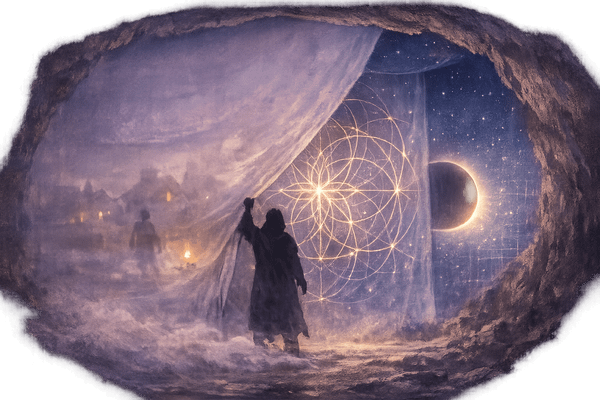
Cosmic Alignment: Tuning Yourself to the Rhythm of the Universe
What does it mean to live in rhythm with the universe? Explore the celestial cycles that shape our world, the spiritual meanings we give them and simple rituals for living with greater awareness.
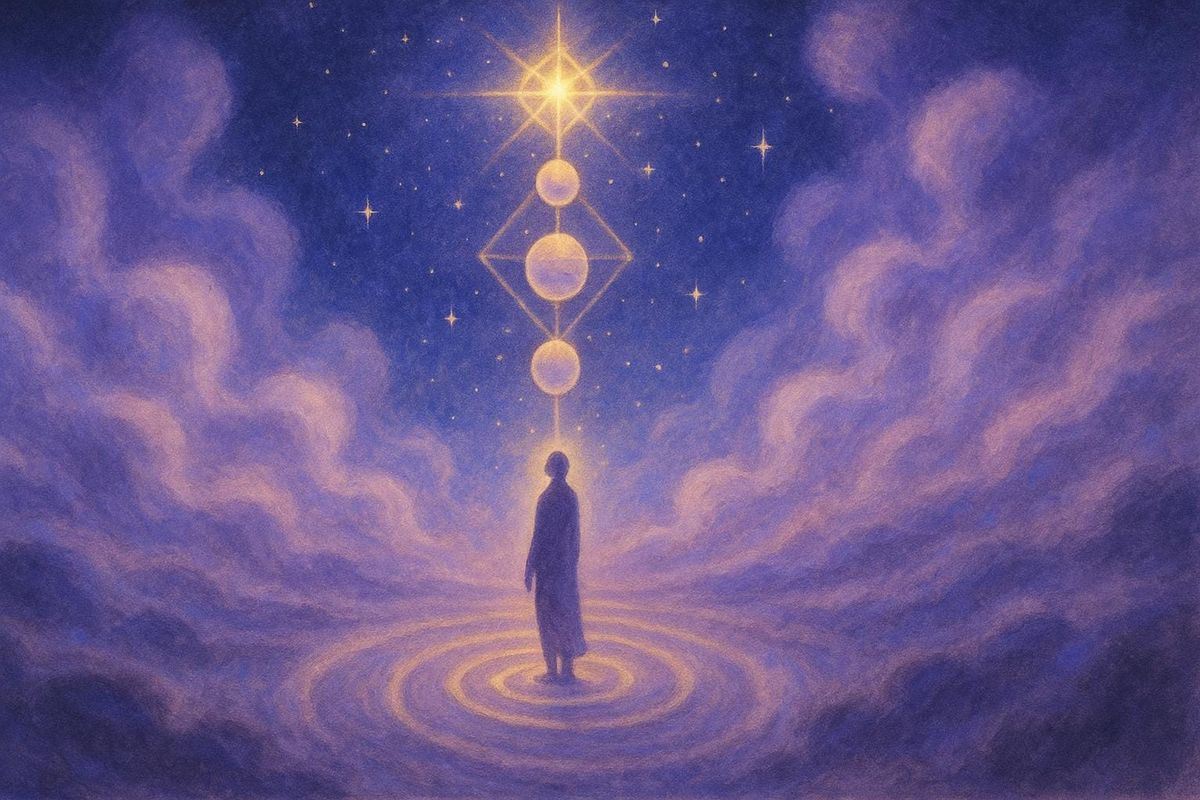
There is a moment before sunrise when the sky seems to hold its breath.
The stars begin to fade, the horizon grows pale and the world moves almost imperceptibly towards morning. Nothing has been instructed to begin. No one has asked the Earth to turn.
Yet the transition arrives. The Sun rises and sets. The Moon changes its visible face. The seasons return. Planets trace their paths across the sky, sometimes appearing to gather together before moving apart again.
We live within these extraordinary rhythms, even when our days are spent beneath artificial lights and our attention rarely travels beyond a screen.
Within contemporary spirituality, cosmic alignment describes the practice of becoming more conscious of our relationship with these larger cycles.
Some understand it as synchronising personal energy with planetary influences. Others use celestial events as moments for meditation, intention and ritual. For still others, alignment means something quieter: living with greater awareness of light, time, rest and the changing natural world.
The distinction matters.
The cosmos genuinely shapes the conditions of life on Earth. Our bodies respond to the daily cycle of light and darkness, while the Earth's annual journey around the Sun gives us the changing seasons.
But that does not establish that a planetary alignment will increase our intuition, that Mercury's apparent retrograde motion will disrupt communications or that the Earth's electromagnetic resonances can be tuned to improve our wellbeing.
The physical relationships are real. The spiritual meanings are interpretations.
Perhaps cosmic alignment becomes most interesting when we allow both to exist without confusing one for the other.
What is cosmic alignment?
Cosmic alignment is an umbrella term rather than one historical spiritual system.
In modern metaphysical practice, it usually means bringing your attention, intentions or activities into a perceived relationship with celestial and natural rhythms.
A practitioner might set intentions around a new Moon, mark the solstice with a ritual, meditate at sunrise or use an astrological calendar as a framework for reflection.
The underlying idea is that human life does not unfold separately from the wider universe.
That much is true in a physical sense. We exist on a rotating planet, receive light and warmth from a star, experience gravity and depend on processes governed by natural laws.
The further claim, that individual decisions become more successful when timed according to particular planetary energies, belongs to a different kind of understanding.
It is a spiritual or astrological interpretation, not an established result of astronomy.
A meaningful cosmic-alignment practice does not have to depend on proving that interpretation.
It can begin with a simpler intention: to become more attentive to the world you live within and more deliberate about how you spend your time.
The rhythms that really shape our lives
Not every natural cycle affects us in the same way.
Some have direct and extensively studied biological consequences. Others are primarily useful as cultural, philosophical or spiritual markers.
Understanding the difference gives us a stronger foundation for practice.
| Rhythm | What is established | How it can inform reflection |
|---|---|---|
| Day and night | Light helps synchronise the body's circadian clocks | Create clearer beginnings and endings to the day |
| The seasons | Earth's axial tilt changes daylight and solar heating across the year | Revisit needs, commitments and activities seasonally |
| Lunar phases | The Moon's changing appearance follows a predictable cycle | Use recurring dates for intention and review |
| Planetary movements | Planets follow measurable orbital paths | Observe the sky or explore traditional astrological symbolism |
| Solar activity | Solar events can affect Earth's magnetic environment and technology | Appreciate our planet's relationship with its star |
| Personal routines | Sleep, activity and social schedules influence daily experience | Notice which rhythms support you and which create strain |
Not every row describes the same kind of influence.
A circadian rhythm is part of human physiology. A planetary-hour ritual is a symbolic practice.
Both may have a place in someone's life, provided we are clear about what each can establish.
Circadian rhythms: the celestial relationship inside the body
If you want an example of genuine alignment between the human body and the external world, begin with the daily cycle of light and darkness.
Our bodies contain biological clocks that organise processes across approximately twenty-four hours.
These circadian rhythms influence sleep, hormone release, appetite, digestion and body temperature.
The human master clock is located within a brain structure called the suprachiasmatic nucleus. It coordinates rhythms throughout the body and responds to information about light received through the eyes.
The US National Institute of General Medical Sciences explains how light and darkness help synchronise these clocks, while factors such as activity, food intake and social schedules also contribute.
This is not a hidden spiritual frequency.
It is an extensively studied biological relationship with the daily environment.
And it suggests something practical.
Before searching for an ideal planetary hour in which to begin your morning, consider whether you have allowed yourself a recognisable morning at all.
A simple sunrise practice
You do not need to wake before dawn or perform a complicated ritual.
When you begin your day, take a few minutes to notice the available daylight.
If circumstances allow, step outdoors or spend time near a window while you consider the day ahead.
Ask what matters most today and what kind of pace is realistic.
You might choose one meaningful priority and one thing you do not need to carry.
The sunlight is not transmitting a message about your destiny.
It is a real environmental signal, and the moment can become a symbolic beginning.
Sunset and the art of finishing
Many people have rituals for starting work, but fewer have a deliberate way to stop.
The end of the working day can blur into the evening. Messages continue arriving, unfinished tasks compete for attention and the body is asked to move from activity into rest without a clear transition.
Sunset provides an obvious image for completion.
A short evening practice might involve closing your notebook, reviewing what has been accomplished and writing down anything that genuinely needs attention tomorrow.
Then allow the day to end.
Light exposure in the evening can affect circadian timing, so a quieter lighting environment may also support a more consistent wind-down routine.
The US National Heart, Lung, and Blood Institute explains the relationship between light, the brain's clock and the sleep-wake cycle.
The spiritual significance of sunset can remain personal.
It might represent gratitude, release, surrender or simply the permission to stop trying to complete everything before tomorrow.
The turning year: solstices and equinoxes
The Earth moves around the Sun while rotating on an axis tilted by approximately 23.4 degrees.
That tilt creates the changing seasonal pattern of daylight and solar heating.
The solstices mark the Sun's apparent northernmost and southernmost positions in the sky. The equinoxes occur when the Sun crosses the celestial equator, with day and night approximately equal in length.
These are astronomical events, not moments when the planet's spiritual frequency changes.
NASA's explanation of the seasons shows how the changing angle between Earth and the Sun produces this annual cycle.
For generations, seasonal turning points have also carried cultural and spiritual significance.
They offer natural occasions to recognise what has changed and consider what comes next.
Spring: emergence
Spring can symbolise beginnings, renewed activity and the appearance of things that have been developing out of sight.
It may be a useful time to reconsider an intention or make room for a project.
You do not have to feel energetic merely because the days are lengthening.
The question is what kind of emergence is appropriate for your circumstances.
Summer: expression
Longer days offer an image of visibility, growth and activity.
A summer ritual might involve celebrating something that has developed through sustained attention.
It can also be a moment to consider whether you have mistaken constant activity for genuine progress.
Autumn: discernment
As daylight diminishes, the imagery turns towards harvest, evaluation and preparation.
What has the year produced? Which commitments remain worthwhile? What might need simplifying?
An autumn reflection can honour both achievements and disappointments.
Winter: restoration
The shorter days of winter provide a symbolic space for rest, inward attention and continuity through difficult seasons.
The winter solstice is especially evocative because it marks the point after which the days begin lengthening again in the Northern Hemisphere.
But renewal does not arrive as an instant transformation.
The return of light is gradual.
Our own changes often are too.
The seasonal meanings above are contemplative associations, and the calendar is reversed between the Northern and Southern Hemispheres.
A genuine relationship with nature begins with the season you actually inhabit.
How ancient people aligned with the sky
The relationship between celestial observation and human culture is much older than modern manifestation.
The movements of the Sun, Moon and stars helped people mark time, anticipate seasonal changes and organise communal life.
Some monuments preserve striking evidence of that attention.
Stonehenge, for example, was deliberately arranged in relation to the solstice axis. The midsummer sunrise and midwinter sunset held particular significance within its design.
English Heritage's account of Stonehenge explains the archaeological evidence for these solar alignments while acknowledging that the builders' full beliefs cannot be recovered.
This distinction is important.
An alignment can be measured. The precise spiritual interpretation held by the people who created it may remain uncertain.
Modern practitioners may find meaning in standing at a monument or observing a solstice.
But that does not establish that the place functions as a device for transmitting cosmic consciousness.
The astronomy is remarkable enough without needing to invent an ancient technological explanation.
Explore Stonehenge: The Solstice Gate and the Singing Stones for a deeper journey.
Lunar alignment: a rhythm for reflection
The Moon offers a second natural clock.
Its cycle from new Moon to new Moon lasts approximately 29.5 days, providing a repeating sequence of changing light.
Within modern manifestation practice, those phases are often given symbolic themes: intention at the new Moon, action while it waxes, reflection at the full Moon and release while it wanes.
This can be a useful rhythm for reviewing a goal.
It is not evidence that a particular phase increases the physical power of your thoughts.
The distinction makes the practice more flexible.
You can use the new Moon as a reminder to begin, but you do not need to postpone an important action until it arrives. You can reflect during the full Moon without assuming that every strong emotion has been produced by it.
We have developed this subject in two separate companion articles:
Moon Phases and Manifestation: Timing the Field provides the complete eight-phase ritual guide.
The Moon as Mirror explores the cycle as a framework for emotional reflection and journalling.
Cosmic alignment draws on that work without requiring your whole life to follow a lunar timetable.
Planetary hours: a symbolic clock
Another longstanding approach to celestial timing comes from traditional astrology.
Planetary hours divide the periods between sunrise and sunset, and between sunset and the following sunrise, into twelve parts each.
These are not necessarily sixty-minute hours. Their length varies according to daylight, location and season.
Each interval is assigned one of the seven classical celestial bodies: the Sun, Moon, Mercury, Venus, Mars, Jupiter and Saturn.
The system follows a repeating traditional sequence known as the Chaldean order.
The first planetary hour also determines the planet traditionally associated with the weekday.
| Day | Traditional ruler | Common astrological theme |
|---|---|---|
| Sunday | Sun | Identity, vitality, expression |
| Monday | Moon | Emotion, reflection, care |
| Tuesday | Mars | Action, courage, assertion |
| Wednesday | Mercury | Communication, learning |
| Thursday | Jupiter | Expansion, perspective, generosity |
| Friday | Venus | Connection, beauty, relationships |
| Saturday | Saturn | Structure, discipline, responsibility |
The associations belong to astrology, not to experimentally demonstrated effects of the planets on individual decisions.
Used symbolically, however, they can create a varied weekly rhythm.
You might make Monday a day for checking in, Wednesday a time to attend to correspondence and Saturday a moment to review longer-term commitments.
The value lies in the pattern you create and maintain, not in proving that Mercury has strengthened your emails or Saturn has increased your self-discipline.
Mercury retrograde: reflection without fear
Few astrological ideas have become as familiar as Mercury retrograde.
A delayed message, an equipment failure or a missed train is quickly attributed to the planet's apparent backward movement.
Astronomically, retrograde motion is an effect of perspective.
As Earth and other planets travel along their orbits, a planet can appear to reverse direction against the background stars for a period. Mercury does not literally stop and begin travelling backwards along its orbit.
Astrology assigns further symbolic meanings to these intervals, often involving communication, review and reconsideration.
There is no established evidence that Mercury's apparent motion causes everyday technological or interpersonal problems.
You may still choose to make a retrograde period a reminder to review plans, clarify language or organise unfinished work.
But those are useful activities on an ordinary Tuesday too.
A missed train does not need an astronomical diagnosis.
And an important opportunity does not have to wait for an astrologically favourable day.
Planetary alignments: what is actually happening?
A group of bright planets appearing together in the night sky can be spectacular.
They may seem to form a line or arc, inspiring descriptions such as a planetary parade.
As NASA explains, the planets ordinarily appear near a shared band of sky because their orbits lie roughly within the same plane.
A visual alignment from Earth is not necessarily a precise straight-line arrangement in three-dimensional space.
Nor is it established evidence of a collective shift in consciousness.
The planets continue following their gravitationally governed orbits. Their apparent grouping gives us an opportunity to observe them, not a guarantee that a particular kind of future is approaching.
A skywatching ritual can be wonderfully simple.
Find a safe place with a clear view, identify the visible planets and spend a few minutes contemplating the scale of the solar system.
You may choose to reflect on connection, perspective or the limits of your ordinary concerns.
The event can become meaningful without being treated as a prediction.
The Schumann resonance: Earth's electromagnetic rhythm
Another concept frequently associated with cosmic alignment is Schumann resonance.
This is a genuine physical phenomenon.
Lightning excites extremely low-frequency electromagnetic waves within the cavity formed by Earth's surface and the lower ionosphere.
Under suitable conditions, waves resonate within that cavity. The fundamental mode occurs around 7.8 Hz, with higher modes also present.
NASA's visual explanation of Schumann resonance describes how lightning generates these atmospheric electromagnetic oscillations.
In some spiritual accounts, Schumann resonance is called the heartbeat of Earth and described as a frequency to which human consciousness should be tuned.
The heartbeat phrase is a metaphor.
The phenomenon is not one perfectly fixed number, and the existence of an atmospheric electromagnetic resonance does not establish that listening to a 7.83 Hz recording synchronises your body with the planet or repairs your nervous system.
Similarity between two numerical frequencies is not sufficient evidence of physical entrainment.
You can use the idea of an earthly rhythm poetically. Just keep it distinct from what the instruments actually measure.
Read Frequency: The Invisible Code Running the Whole Show for the broader physics of frequency and resonance.
Crystals and objects in a cosmic ritual
The original attraction of a cosmic-alignment ritual is often sensory.
A stone rests in your hand. A candle marks a turning point. A bowl of water reflects the sky. A notebook holds an intention that would otherwise be lost among ordinary thoughts.
These objects can give the practice shape.
Some contemporary practitioners associate particular crystals with planetary events or leave them beneath the Moon to charge.
There is no established evidence that such rituals store a celestial energy within the stone or enable it to alter external events.
Their symbolic value is a separate matter.
You might use a dark stone to represent steadiness, a clear one to represent clarity or an ordinary object collected on a walk to represent a connection with place.
Choose something meaningful rather than accepting a universal prescription.
A ritual should not require expensive equipment.
Nor should you expose yourself or others to unsafe practices in order to perform it. Smoke, flames and any materials placed in water deserve ordinary care.
The sky itself is free.
Grounding: from cosmic ideas to the present moment
Grounding is another word used in several different ways.
In electrical engineering it has a specific physical meaning. In psychology and everyday wellbeing, it often refers to practices that help someone orient themselves towards the present.
In spiritual work, grounding may be described as connecting with Earth energy.
These meanings should not be collapsed into one mechanism.
For a simple reflective practice, go outdoors if you can.
Notice the temperature, the air, the ground beneath your feet and the sounds around you.
If you choose to walk barefoot, use a safe surface. There is no need to expose yourself to injury or uncomfortable conditions to prove that you are spiritually connected.
You might also sit in a garden, tend a plant or take a familiar route without looking at your phone.
The purpose is not to absorb a medically established planetary charge.
It is to return attention to the environment in which you actually live.
Synchronicity and the feeling of being aligned
When we begin paying closer attention to a particular theme, related experiences may seem to appear everywhere.
You think about an old friend and hear their name. You make a decision and encounter a phrase that seems to confirm it. Several events unfold in a sequence that feels unusually meaningful.
Within Jungian thought, synchronicity describes meaningful coincidence understood as something more than an ordinary causal connection.
Contemporary spiritual practice often treats synchronicities as signs of alignment.
Such experiences can be affecting, especially when they occur during periods of change.
But an event's personal meaning does not establish its supernatural origin.
Our attention, expectations and memory influence which coincidences stand out.
A useful approach is to ask what the experience brings to mind without treating it as an instruction.
Perhaps it reminds you of a neglected hope. Perhaps it encourages you to examine a choice.
You can honour that meaning while still checking facts, respecting other people's decisions and remaining open to coincidence.
A sign does not have to become a command.
A personal cosmic calendar
The most practical way to work with cosmic alignment is to build a rhythm that reflects your actual life.
Rather than filling the calendar with every astrological transit, begin with four recurring moments.
| Rhythm | Practice | Useful question |
|---|---|---|
| Daily | Morning intention and evening closure | What matters today, and what can I leave until tomorrow? |
| Weekly | Brief review | What is working, and what needs attention? |
| Lunar | One or two check-ins each cycle | What is emerging, changing or complete? |
| Seasonal | Solstice or equinox reflection | What does this period of life ask me to cultivate or release? |
A particularly meaningful event may deserve a longer ritual.
Most days will not.
The rhythm should provide structure without turning ordinary living into constant spiritual administration.
If you miss a phase or forget an observance, simply return when you are ready.
The planets have not invalidated your intention.
A seven-minute celestial alignment meditation
This is a personal contemplative exercise, not a technique for altering electromagnetic fields or receiving verified information from planetary forces.
Sit comfortably, with your eyes open or closed.
Imagine the Earth turning beneath the stars.
You are not separate from that movement. Your ordinary life unfolds on this planet, carried through day and night by its rotation.
Notice the surface supporting you.
Allow your breathing to find a comfortable rhythm without forcing it.
Now imagine the horizon at dawn. Light slowly reaches the landscape.
Ask yourself what you wish to bring into the day.
Let the answer be simple: patience, clarity, courage, kindness or a willingness to begin.
Imagine the Sun moving across the sky, marking the passing of time.
Consider where your attention has been going. Is there something that deserves more of it? Something that deserves less?
Allow the imagined sky to darken.
A Moon appears, followed by stars.
You may picture the familiar planets moving within the wider solar system, each following its own path.
Remember that your life also contains more than one rhythm. There are times for action, times for uncertainty and times for rest.
You do not need to resolve everything in this moment.
Bring attention back to your surroundings and write down one practical action that reflects the quality you chose.
The meditation ends in the present.
That is where your next choice can be made.
What does long-term alignment look like?
Long-term alignment is not a state of perfect harmony in which every decision feels effortless.
There will be disruption, uncertainty and periods when even a well-established routine becomes impossible.
The practical question is what helps you return.
Perhaps morning daylight makes the beginning of the day feel more distinct. Perhaps a weekly review prevents small problems from becoming larger ones. Perhaps the lunar cycle reminds you to stop, while the seasonal calendar encourages you to reconsider commitments that no longer fit.
The pattern will differ from person to person.
Your work, family, health, location and responsibilities all influence the rhythms available to you.
A person working shifts cannot organise their life around sunrise in the same way as someone with a regular daytime schedule.
An individual caring for a child or family member may have little control over their sleep.
Spiritual practice should respond to these realities rather than treating them as evidence of poor alignment.
Sometimes the most meaningful ritual is the one you can actually sustain.
When cosmic alignment becomes restrictive
There is a shadow side to any framework that promises guidance.
A person may become afraid to begin a project during Mercury retrograde, postpone a necessary conversation until a favourable planetary hour or interpret an ordinary difficulty as evidence that the universe is opposing them.
The calendar has moved from being a source of reflection to becoming a source of anxiety.
The same can happen when every unexpected event is treated as a synchronicity demanding interpretation.
You are not required to decode the universe before making a decision.
A useful spiritual framework should help you become more attentive, not less free.
If an astrological or energetic interpretation increases fear, encourages you to ignore evidence or makes you dependent on someone else's predictions, it is reasonable to step away from it.
You can return to the direct experience of the sky.
Sunrise still arrives. The Moon still changes. The seasons continue without asking for an interpretation.
The universe does not need to send you instructions to be meaningful
We sometimes imagine alignment as receiving a secret message.
A planet moves into a particular position. A number appears. A chance encounter seems to confirm a desire.
Perhaps the mystery of the cosmos makes us want to believe that its vast machinery has noticed our individual lives.
There is tenderness in that wish.
But the universe offers another kind of connection that does not depend on personalised instructions.
The light entering your window began at the Sun. The elements within your body have a history extending far beyond any single human life. The ground beneath you, the air you breathe and the changing sky are part of the same physical world.
You belong to that story without having to prove that it was written for you.
A spiritual interpretation can add meaning to this relationship.
It can turn sunrise into gratitude, the solstice into reflection or the night sky into a reminder of perspective.
The meaning is real as an experience, even when the interpretation remains open.
Tuning yourself to the rhythm of the universe
Perhaps cosmic alignment is less about discovering the correct frequency and more about remembering that life has different tempos.
A beginning asks something different of us from an ending. Action is not the same as reflection. Rest is not a failure to manifest.
The cosmos demonstrates these changes without turning them into moral judgements.
The Sun does not rise more successfully on one morning than another. The Moon is not broken when its light disappears. Winter is not a mistake made by summer.
We can draw something from that image.
We may need periods of visible movement and periods in which change is not obvious. We may need to make a decision, reconsider it or allow an experience to settle.
A cosmic practice gives those movements a place in our attention.
The sky becomes a calendar, the seasons become reminders and ritual becomes a way of meeting the present deliberately.
We do not have to pretend that planetary motion controls our destiny.
There is enough wonder in noticing that we are here, beneath the same turning sky, with another opportunity to choose how we live.