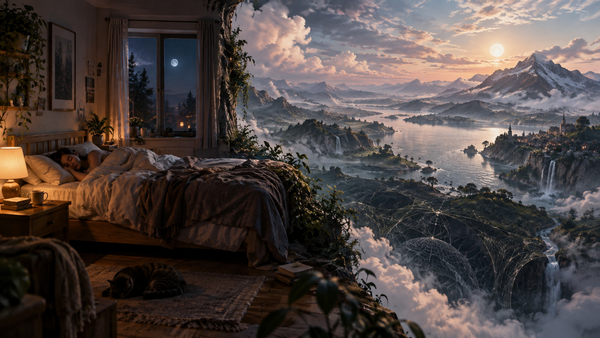
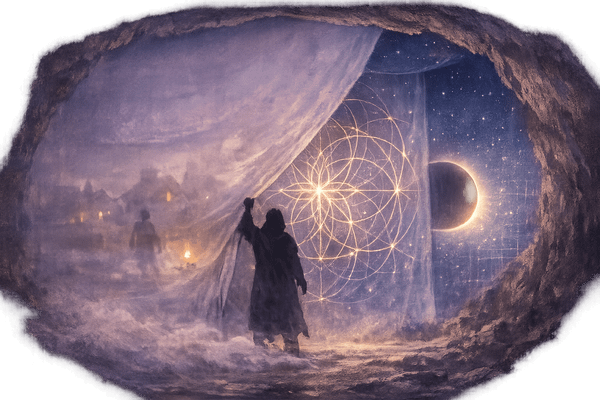
Mount Shasta: Sacred Mountain, Lemurian Legends and the Mysteries of the Volcano
Mount Shasta is a vast active volcano, a sacred Indigenous landscape and one of America's great centres of modern metaphysical mythology.

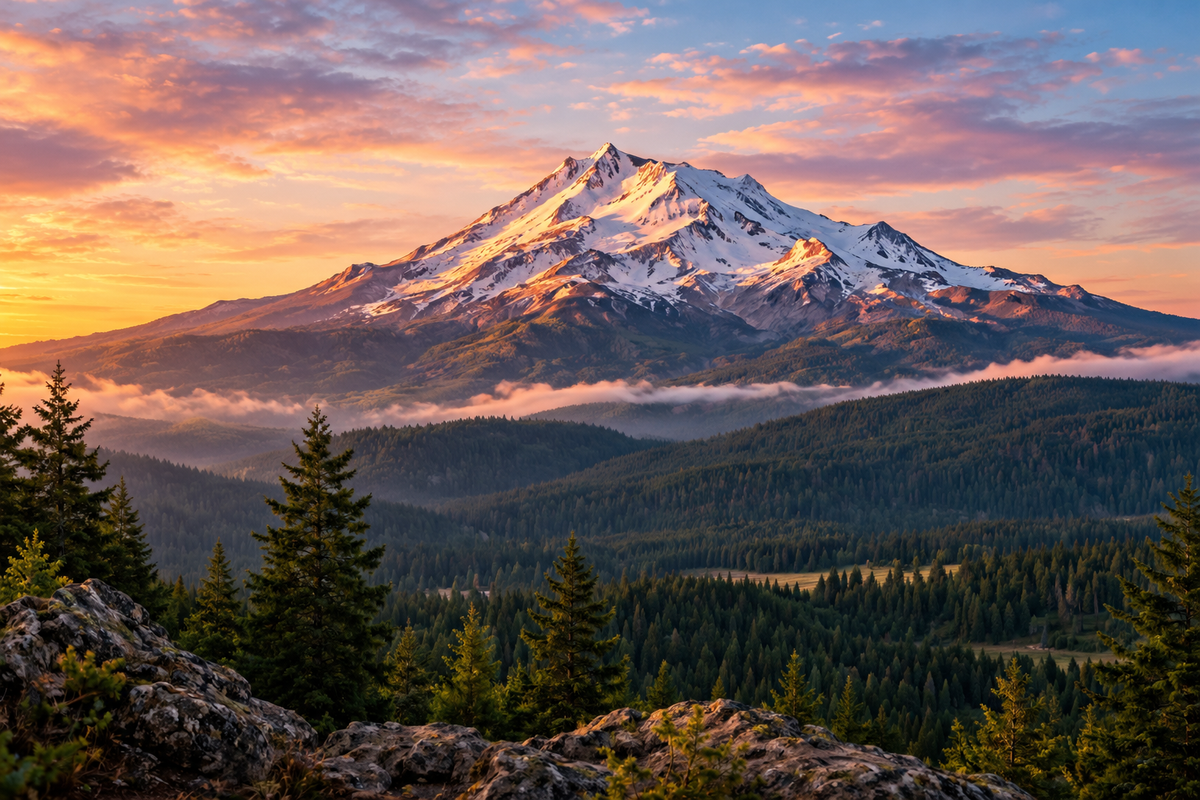
Mount Shasta dominates the landscape of northern California in a way that is difficult to understand until you see it.
Rising to more than 14,000 feet, the snow-covered volcano towers above forests, towns and highways, often visible from great distances. It is one of the largest volcanoes in the Cascade Range and remains geologically active.
It is also one of the most mythologised mountains in North America.
Indigenous peoples have regarded the mountain as sacred for generations. Later spiritual movements added stories of hidden masters, lost civilisations, underground cities, UFOs, energy vortexes and planetary chakras.
Some of those traditions are old. Others are surprisingly recent.
Mount Shasta becomes far more interesting when we understand how those layers accumulated.
A very real volcano
Mount Shasta is a massive compound stratovolcano in northern California, around 60 miles north of Redding.
The United States Geological Survey places its summit at approximately 14,163 feet, or 4,317 metres. It is the most voluminous volcano in the Cascade Range and is built from multiple overlapping volcanic cones.
The mountain has developed over hundreds of thousands of years.
An earlier version of Mount Shasta suffered a catastrophic collapse around 300,000 years ago, producing one of the largest known landslides on Earth. The modern volcano then grew through repeated episodes of lava flows, ash, pyroclastic activity and mudflows.
Its most recent confirmed eruption occurred around 3,200 years ago.
That makes Shasta dormant in everyday terms, but not extinct.
USGS monitoring continues because the volcano is considered capable of future eruptions.
Glaciers, springs and scale
Mount Shasta also holds several glaciers, including Whitney Glacier, the largest glacier in California.
Snow and ice feed streams that flow towards the Sacramento, Shasta and McCloud river systems. The mountain therefore affects the landscape far beyond its visible slopes.
Its physical scale matters when thinking about its spiritual reputation.
Large isolated mountains repeatedly become sacred in human cultures because they dominate the horizon, influence weather and water, and create a powerful sense of vertical separation between ordinary ground and the sky.
Mount Shasta does all of those things exceptionally well.
A sacred Indigenous landscape
Long before Mount Shasta became famous among metaphysical seekers, it held deep significance for Indigenous peoples of northern California.
Different Native nations have distinct traditions connected with the mountain and surrounding region. These traditions should not be collapsed into one generic "Native American belief system", and they should not automatically be blended with later New Age ideas about chakras or Lemuria.
The mountain is culturally significant within Indigenous landscapes that extend well beyond the summit itself.
That means modern spiritual visitors are entering a place that was already sacred before twentieth-century occult movements began constructing their own mythology around it.
Respecting that distinction matters.
Sacred does not mean public property
Modern seekers sometimes approach Mount Shasta as though every spiritually interesting location exists for unrestricted ritual use.
That can create tension.
Some high-elevation meadows and other sensitive areas are ecologically fragile and culturally important. Forest Service visitor studies have specifically highlighted the need for clearer guidance around respecting sacredness and staying on trail at places such as Panther Meadows.
If you visit Shasta for spiritual reasons, the most respectful approach is simple: do not assume that your personal ritual takes priority over the land, its ecology or other traditions connected to it.
How Mount Shasta became an occult mountain
The more unusual Mount Shasta mythology grew largely during the late nineteenth and twentieth centuries.
The mountain became a magnet for spiritual movements concerned with hidden masters, lost civilisations and higher states of consciousness.
Over time, Shasta accumulated stories involving:
- Lemuria
- Telos
- Ascended Masters
- Saint Germain
- underground cities
- UFOs
- vortex energy
- planetary chakras
- portals and dimensional gateways
These traditions did not emerge all at once. They accumulated in layers.
Lemuria
The story of Lemuria began far away from Mount Shasta.
In the nineteenth century, scientists proposed a hypothetical lost landmass to explain similarities between animal species found in distant regions. The idea was eventually discarded as modern geology and plate tectonics provided better explanations.
Occult writers then transformed Lemuria from a scientific hypothesis into a lost civilisation.
In later Theosophical and esoteric traditions, Lemurians became spiritually advanced ancient beings associated with vanished continents and hidden wisdom.
By the early twentieth century, Mount Shasta had become one of the places where those stories were relocated.
Lemurians beneath the mountain
Stories gradually emerged claiming that survivors of Lemuria had established a hidden community within Mount Shasta. Accounts vary widely. Some describe an underground civilisation.
Others claim Lemurians live in a higher dimension inaccessible to ordinary perception. Stories of unusually tall, white-robed figures appearing around the mountain also became part of local occult folklore.
Academic work examining spiritual tourism at Mount Shasta traces the elaboration of the Lemurian myth particularly through twentieth-century groups and writers, with the tradition becoming increasingly elaborate from the 1930s onward. :
There is no archaeological or geological evidence for an advanced underground Lemurian civilisation. That does not mean the story is irrelevant. It has become one of Mount Shasta's defining modern myths.
Telos
The hidden city most commonly associated with Mount Shasta today is Telos.
Within modern metaphysical tradition, Telos is described as a city inhabited by spiritually advanced Lemurian beings living within or beneath the mountain.
Some versions place it physically underground. Others describe it as existing on another vibrational level or dimension.
The idea was developed particularly strongly through modern channelling literature, including the writings of Aurelia Louise Jones, who described communication with a Lemurian master named Adama. Academic studies of Mount Shasta spirituality identify the Telos material as an important later development of the broader Lemurian legend.
There is no physical evidence for Telos. It belongs to channelling and modern esoteric tradition.
Ascended Masters
Another major strand of Shasta spirituality involves Ascended Masters.
These are beings described within several modern esoteric traditions as spiritually evolved teachers who have transcended ordinary human existence.
Mount Shasta became especially associated with Saint Germain, a figure who occupies an important role in twentieth-century Ascended Master teachings.
The mountain's reputation was strengthened by Guy Ballard, founder of the "I AM" Activity, who described a transformative encounter near Mount Shasta in the early 1930s.
Those experiences helped make the mountain an important location within American metaphysical spirituality. Again, the distinction is useful. There is documented history showing that people developed and taught these beliefs around Mount Shasta.
Whether the supernatural beings they described objectively exist is a separate question.
Mount Shasta as an energy vortex
Today, Mount Shasta is frequently described as an energy vortex.
Visitors report sensations including:
- unusual calm
- heightened emotion
- tingling or bodily sensations
- vivid dreams
- synchronicities
- stronger meditation
- sudden insight
- a sense of presence or connection
Some spiritual guides identify particular locations around the mountain as especially energetic.
The problem is that "vortex" does not describe an accepted geophysical category.
There is no scientific evidence demonstrating a unique subtle-energy vortex surrounding Mount Shasta.
That does not make individual experience meaningless.
As with Sedona, it changes the question.
Instead of asking only whether a measurable vortex exists, we can ask why this particular landscape repeatedly produces powerful experiences and spiritual interpretations.
Is Mount Shasta electromagnetic?
Claims about Mount Shasta's spiritual energy are sometimes justified by references to electromagnetism.
The mountain is volcanic, geologically complex and actively monitored. Volcanic landscapes can certainly contain variations in rock composition, magnetic properties, geothermal activity and local geophysical conditions.
That is not the same as demonstrating that Mount Shasta emits a consciousness-enhancing electromagnetic field.
The USGS describes a complex and still-hot volcanic system, including hot springs and volcanic gases near the summit.
Those are real geological phenomena.
They should not automatically be converted into evidence for chakra activation or spiritual vortexes.
The planetary chakra idea
Mount Shasta is also frequently described as one of the chakras of the Earth.
Different systems assign different chakra identities to different sacred locations. In some versions, Shasta represents the root chakra. Other systems pair it with another location or assign a different energetic function.
There is no single ancient planetary-chakra tradition.
These systems are modern attempts to map the human subtle-body model onto the Earth.
As metaphysical symbolism, the idea can be compelling.
Mount Shasta certainly looks like a root or anchor point in the landscape: enormous, volcanic and physically dominant.
But the chakra designation is a spiritual model, not a scientific description of the mountain.
Panther Meadows
One of the places most frequently mentioned in modern Shasta spirituality is Panther Meadows, a high-altitude meadow on the mountain. The area attracts hikers, contemplative visitors and spiritual seekers.
Its ecological sensitivity is important. High mountain meadows can be easily damaged by repeated trampling, off-trail walking and informal ritual activity.
If you visit, stay on established routes and avoid leaving crystals, offerings, cairns or other objects.
A sacred-place practice should not damage the place being treated as sacred.
Ascension Rock
Ascension Rock is another location associated with modern spiritual activity around Mount Shasta.
The name itself reflects the language of contemporary metaphysical practice.
Visitors may meditate, conduct rituals or use the landscape as a focus for ideas about spiritual transformation and ascension.
There is no need to dismiss that practice.
But it should be understood as part of Mount Shasta's modern spiritual culture rather than evidence for an ancient ritual tradition.
UFOs and lenticular clouds
Mount Shasta has also accumulated a substantial UFO mythology. Some visitors report unusual lights or craft around the mountain. Its frequent lenticular clouds help the story along.
These smooth, lens-shaped clouds form when moist air flows across mountainous terrain and can create extraordinary formations that resemble discs or stacked spacecraft.
That explains some photographs interpreted as UFOs. It does not explain every unusual aerial report people have made around Shasta.
The mountain's existing reputation also matters: once a place becomes associated with anomalous phenomena, visitors naturally pay more attention to anything unusual in the sky.
Why Mount Shasta generates myths
There is a straightforward reason Mount Shasta has become such fertile ground for extraordinary stories.
It is visually overwhelming. It is isolated enough to dominate the horizon. Snow and cloud frequently obscure parts of it. Its volcanic geology reminds visitors that immense forces exist below the surface. Forests and wilderness surround it.
The mountain also changes dramatically with weather and light. All of those features create the perfect conditions for a sacred mountain.
Once a powerful mythology forms, each new generation interprets the place through the stories it inherited.
The mountain remains the same. The meanings multiply.
Visiting Mount Shasta
Mount Shasta is not one attraction with a single entrance. The wider landscape includes forests, hiking routes, high-elevation roads, lakes, meadows and wilderness areas.
Conditions vary enormously with altitude and season.
Snow can remain at higher elevations long after lower areas are warm, and mountain weather can change quickly. If you plan to climb high on the mountain rather than simply explore accessible trails and viewpoints, treat it as serious mountain terrain rather than a spiritual walk.
Check current Forest Service conditions before setting out.
What is documented and what belongs to tradition?
Mount Shasta contains unusually clear examples of several different kinds of sacred-place claim.
Documented
- Mount Shasta is a massive active stratovolcano in the Cascade Range.
- Its volcanic system has developed over hundreds of thousands of years.
- It contains major glaciers and feeds important river systems.
- The mountain and surrounding landscape have long-standing cultural and sacred significance for Indigenous peoples.
- Modern occult and metaphysical movements began associating Mount Shasta with Lemuria, Ascended Masters and related beliefs particularly during the twentieth century.
Tradition and interpretation
- Lemurian survivors are said to live beneath the mountain.
- Telos is described as a hidden or higher-dimensional city within Mount Shasta.
- Ascended Masters including Saint Germain are associated with the mountain.
- Visitors describe vortex energy and spiritual activation.
- Some planetary-chakra systems identify Shasta as the Earth's root chakra.
- UFO and dimensional-portal traditions have also developed around the mountain.
These ideas are important to Mount Shasta's modern cultural identity.
They are not established geological or archaeological facts.
Why Mount Shasta remains compelling
Mount Shasta does not need Lemuria to be extraordinary.
It is already one of the largest volcanic structures in the Cascade Range, covered with ice, shaped by catastrophic geological events and visible across enormous distances.
But the legends tell us something too. Mountains invite vertical imagination. The summit becomes heaven. The interior becomes another world. Clouds become portals. Hidden valleys become refuges. Volcanoes become sources of power.
Mount Shasta has accumulated almost every version of that ancient human instinct, translated into the language of modern American metaphysics.
That is what makes it such a fascinating place.
Frequently asked questions
Is Mount Shasta an active volcano?
Yes. Mount Shasta is an active stratovolcano monitored by the USGS. Its most recent confirmed eruption occurred around 3,200 years ago.
How high is Mount Shasta?
The USGS gives an elevation of approximately 14,163 feet, or 4,317 metres.
Is there really a city called Telos beneath Mount Shasta?
There is no archaeological or geological evidence for an underground city called Telos. It belongs to modern Lemurian and channelling traditions associated with the mountain. Use your own judgment.
Why is Mount Shasta linked to Lemuria?
Twentieth-century esoteric movements connected the mountain with the older occult idea of Lemuria, eventually developing stories of Lemurian survivors living within Mount Shasta.
Is Mount Shasta an energy vortex?
Many modern spiritual practitioners describe it that way and visitors report powerful subjective experiences. No scientifically recognised energy vortex has been demonstrated.
Is Mount Shasta the Earth's root chakra?
Some modern planetary-chakra systems identify it as a root-chakra location. This is a contemporary metaphysical model rather than an ancient or scientifically established classification.
Can you climb Mount Shasta?
Yes, but summit routes involve serious mountaineering conditions. Check current Forest Service guidance, weather and route conditions before attempting high-elevation travel.
Continue exploring
What Is an Energy Vortex?
Explore how vortex traditions developed and what people report experiencing at places such as Sedona and Mount Shasta.
How to Recognise an Energy Node
A broader guide to sacred places, powerful landscapes and the different ways people interpret them.
The Earth's Energy Grid
Explore the modern idea that sacred sites, nodes and vortexes form a connected planetary network.