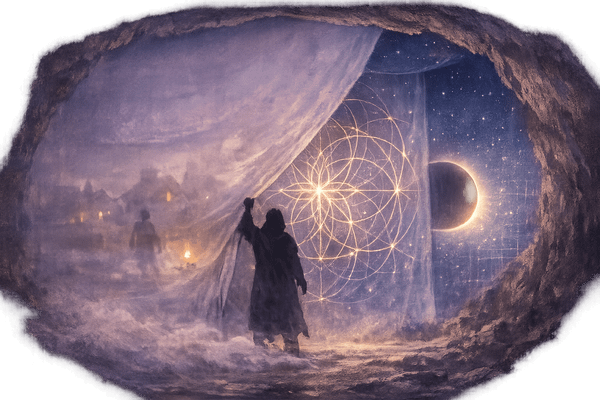
When the Future Visits You: How Precognitive Dreams Work
Some dreams seem to describe events before they happen. Are they coincidence, unconscious prediction or evidence that consciousness sometimes reaches beyond linear time?


Sometimes a dream feels different before anything has happened.
You wake with an image that refuses to dissolve. A particular street. A person saying an oddly specific phrase. A room you have never seen. A train stopping where it should not. You write it down, perhaps because the details feel unusually sharp.
Then, three days later, something happens. You hear the phrase. You enter the room. The train stops. The person appears.
Only now does the dream acquire a second life. What had been strange becomes unsettling.
Precognitive dreams sit in an awkward place. They are common enough to be part of folklore across cultures, personal enough that people often feel certain about what happened, and difficult enough to test that almost every dramatic example can be challenged.
The central question is simple: can a dream contain information about an event that has not yet happened?
We do not currently have a scientific answer that establishes that it can.
But the better cases deserve more than a shrug.
What counts as a precognitive dream?
A precognitive dream is usually defined as a dream that appears to correspond with a later event in a way that could not reasonably have been known in advance.
That definition hides the hard part.
Human beings dream a lot. Most of those dreams disappear within minutes of waking. The ones we remember contain places, people, danger, conversations, objects, accidents, journeys, sex, work, family and countless fragments of everyday life.
Given enough dream material and enough waking life, some overlap is inevitable.
You dream about an old friend. They message two days later. You dream about a storm. It rains. You dream about somebody becoming ill, then discover that they have a cold.
None of these requires information to have travelled backwards through time. Coincidence alone can produce striking matches.
A stronger case has more demanding features. The dream was recorded before the event. It contained several specific details. Those details were difficult to infer from information already available. The dreamer did not later cause the event through their own behaviour. Ideally, someone else saw the record before the event occurred.
That moves us from I remember dreaming something like this to a much more interesting question: What exactly was recorded, and when?
That is where precognitive dreams become testable rather than simply memorable.
Your dreaming brain is already trying to predict tomorrow
There is a thoroughly ordinary reason dreams can sometimes seem predictive.
Your brain predicts things constantly.
It notices tension in a relationship before you consciously admit it. It detects small changes in somebody's health. It registers patterns in work, family, weather, money, behaviour and risk. Much of that processing happens below conscious awareness.
Researchers have tested whether apparently precognitive dreams might emerge from unconscious processing of environmental information. That explanation is attractive because we often absorb more information than reaches conscious attention.
Dreaming also appears to be far more future-facing than the old idea of dreams as random mental debris suggests. Dreams can combine memory with anticipation, constructing possible situations and rehearsing what might happen next.
There are also theories proposing that dreams rehearse danger. Threat simulation theory, for example, suggests that dreaming may help us model threatening events and practise responses to them.
So a dream that seems to anticipate a relationship ending, a work crisis or an accident may sometimes represent remarkably good unconscious forecasting.
That is still prediction.
It just does not require precognition.
This is also one reason our wider exploration of what dreams might reveal about the structure of reality becomes interesting. Dreams do not simply replay yesterday. They continually construct worlds from fragments of memory, expectation and imagination.
Memory makes the problem harder
Dream memory is slippery.
Most dreams are forgotten. The fragments that remain are often reconstructed. Once a real event occurs, the mind can revisit an earlier dream and unconsciously improve the match.
A vague dream about being somewhere crowded can become, in retrospect, the station where something later happened. A dream involving water can begin to feel uncannily specific after a flood. Details from the later event can migrate backwards into the remembered dream.
This is one reason the frequency illusion matters here. Once something becomes significant, our attention reorganises around it. We notice matches more readily than misses.
The same problem appears with synchronicities. A correspondence can feel extraordinary while still being difficult to separate from coincidence, selection and retrospective interpretation.
Dreams create an even larger field in which that can happen.
Suppose you record five dreams a week. That is about 260 dreams a year. Each contains dozens of elements: colours, places, objects, emotions, people, phrases and actions.
You now have thousands of opportunities for waking life to rhyme with something you dreamed.
Some of those rhymes will feel extraordinary.
The case that still haunts the subject: Aberfan
At 9.15am on 21 October 1966, a colliery spoil tip collapsed above the Welsh village of Aberfan. The avalanche struck Pantglas Junior School and nearby houses. One hundred and forty-four people died, including 116 children.
In the aftermath, psychiatrist John Barker began collecting reports from people who claimed to have experienced premonitions of the disaster.
One of the most famous involved ten-year-old Eryl Mai Jones, who died at Pantglas.
According to accounts gathered after the disaster, Eryl had told her mother about a dream the previous day in which she went to school and found that the school was gone because something black had come down over it.
It is a chilling story.
It is also important to examine how the evidence was collected.
Barker appealed publicly for reports after Aberfan had happened. He received dozens of responses and attempted to distinguish accounts that had apparently been shared with another person before the disaster from those recalled only afterwards.
That is better evidence than a memory reported by one person after an event.
It still has weaknesses.
Barker knew what had happened before he gathered the reports. Witnesses knew what had happened. Memory, interpretation and selection could all affect which premonitions were reported and which details seemed significant.
Barker himself recognised the problem.
His later work with science journalist Peter Fairley led to the creation of the British Premonitions Bureau, which attempted to collect predictions before events occurred. Reports could then be dated and compared with later events.
That methodological shift is the interesting part of the story.
A prophecy collected after a disaster is compelling testimony.
A precise prediction recorded before a disaster is evidence of a different kind.
Lincoln, Twain and the problem with perfect stories
History is full of famous dreams that appear to predict death.
Abraham Lincoln supposedly dreamed of entering the East Room of the White House, seeing a corpse and being told that the president had been killed by an assassin.
The source usually cited is Lincoln's friend Ward Hill Lamon, who said Lincoln described the dream shortly before his death.
But the surviving account was published years after Lincoln's assassination.
It remains a fascinating historical report.
It is not a timestamped dream diary.
Mark Twain's story is stranger still.
Twain later wrote that he dreamed his brother Henry lying dead in a metal coffin supported on chairs, with flowers on his chest. Weeks later, Henry died after injuries sustained in a steamboat explosion, and Twain believed aspects of the scene around his brother's body closely resembled the dream.
Again, the account survives through Twain's later recollection.
These stories are worth reading because they show exactly why precognitive dreams are so difficult to study.
The most beautiful cases often arrive wrapped in memory.
What happens when precognition is tested?
This is where the subject becomes more uncomfortable.
Research into precognition and related phenomena exists, and some published experiments have reported small effects that researchers argue cannot easily be explained by chance.
One line of research has examined presentiment: whether physiological measures such as skin conductance or heart rate appear to change shortly before participants are shown randomly selected emotional or neutral images.
Some analyses have reported small anticipatory effects.
Other experiments have claimed behavioural evidence suggesting that people respond differently depending on events that, from their perspective, have not yet occurred.
The controversy around this work is substantial.
Precognition research is unusually vulnerable to analytical flexibility, publication bias and replication problems. Attempts to reproduce some of the best-known findings have produced mixed or negative results.
There is no settled experimental demonstration that people can access future information.
There is, however, enough disputed and unusual research around anticipation, timing and consciousness to explain why the question has not disappeared.
For Sacred Illusion, that is the useful position.
We do not need to pretend the evidence is stronger than it is.
We also do not need to declare the investigation closed.
What if time does not work the way it feels?
Our experience of time is brutally convincing.
Yesterday is gone. Tomorrow does not exist yet. We move through a narrow present.
Physics and philosophy do not force us to treat that intuitive picture as the only possible description of time.
One long-standing view is eternalism, sometimes described through the block universe model. On this view, past, present and future can be understood as parts of a four-dimensional structure rather than reality being continuously created at a moving present moment.
This does not mean physics predicts precognitive dreams.
It does something subtler.
It weakens the assumption that our everyday experience of time tells us everything about the underlying structure of time.
This connects with the strange temporal experiences we explored in Déjà Vu and the Illusion of Time. Consciousness gives us an experience of a moving present, but that experience may not be a complete map of reality itself.
Even if future events are in some sense as real as past events, we would still need a mechanism explaining how information from one temporal location could become available to consciousness at another.
No such mechanism has been established.
Quantum mechanics is sometimes dragged into this gap far too quickly. Entanglement, retrocausality and quantum measurement are fascinating areas of physics, but none currently provides an accepted explanation for prophetic dreams.
“Quantum” cannot do the work simply because the phenomenon is mysterious.
Could consciousness relate to time differently in dreams?
This is the more interesting speculative question.
Waking consciousness is heavily occupied.
Your senses continually update your model of the present. Attention selects useful information. Goals organise thought. Your body tells you where you are. The physical world keeps correcting your imagination.
During dreaming, much of that external constraint loosens.
Memory fragments combine. Identity shifts. Places merge. Time jumps. People who died years ago sit beside people you met yesterday. A childhood home can contain a room from a house you have not visited in twenty years.
Dreams already treat time with astonishing freedom.
That does not prove they access the future.
But if consciousness ever did process information in a way that did not map neatly onto waking linear time, dreaming would be an obvious state in which to look for it.
The mind is less occupied with constructing a reliable sensory present.
That leaves room for experiences that waking consciousness normally filters out, whether they come from memory, prediction, imagination or something we do not yet understand.
Synchronicity offers another way of looking at it
Carl Jung's idea of synchronicity offers a model that avoids the image of a message literally travelling backwards through time.
A dream and a later event could be related through meaning rather than conventional cause.
This would make a precognitive dream less like tomorrow sending a postcard to yesterday and more like two events participating in the same pattern.
That idea remains philosophical rather than experimentally demonstrated.
But it fits an odd feature of many reported precognitive dreams: they often feel symbolic before they feel predictive.
A dream contains an image.
Later, reality appears to answer it.
Readers who have explored How to Read Synchronicities will recognise the problem. Meaning can be real to the person experiencing it while remaining difficult to separate from pattern recognition, coincidence and retrospective interpretation.
The strongest approach is simple.
Record first. Interpret later.
Simulation theory creates an even stranger possibility
If reality is fundamentally informational, some of our assumptions about past and future may need rewriting.
A simulated or computational reality would not automatically permit precognition. Characters inside a computer simulation do not necessarily have access to later states of the programme.
But the analogy raises an interesting question.
What if consciousness has access to information at a level that ordinary waking perception does not?
A player can know things unavailable to a character.
A system administrator can inspect states inaccessible from within a programme.
A simulation can contain data about events before those events are rendered from the perspective of an observer.
There is no evidence that dreams operate this way.
It remains an interesting model because it shifts the question from supernatural prophecy to information access.
That brings us back to what dreams might reveal about the source code of reality and the wider question explored in Can We Prove We're in a Simulation?.
If consciousness and information are more deeply related than our current models suggest, dreams may be one of the stranger places to look for clues.
What about timelines and branching realities?
Another interpretation sometimes applied to precognitive dreams comes from branching or multiple-reality ideas.
Perhaps a dream does not reveal the future. Perhaps it depicts one possible future. That could explain why some seemingly prophetic dreams appear close but not exact, or why an expected event fails to occur.
The problem is obvious: a theory that can explain both a hit and a miss becomes very hard to test.
If the dream happens, it was precognition.
If it does not happen, the timeline changed.
That may be metaphysically possible. It is poor evidence.
Anyone exploring Timeline Jumping 101 should keep that problem in view. Interesting models become much more useful when there is some conceivable result that could count against them.
How to test your own precognitive dreams
If you genuinely think you experience precognitive dreams, treat yourself as an experiment.
Do not rely on memory. Build a record.
- Write the dream down immediately. Capture it before checking messages, news or social media.
- Date and time the entry. A digital record with an automatic timestamp is useful.
- Do not edit the original. Add later thoughts separately.
- Separate description from interpretation. “Red umbrella beside a broken bicycle” is data. “This means my sister will have an accident” is interpretation.
- Record the misses. A diary containing only spectacular hits tells you almost nothing.
- When something happens, compare it with the original entry. Do not compare the event with your memory of the dream.
- Score specificity conservatively. “A plane” is broad. A particular airline, airport, colour, number and sequence of events is much harder to match by chance.
- Ask what you already knew. Could unconscious cues have allowed you to anticipate the event?
- Ask whether your behaviour helped cause it. Dreams can change our choices.
- Collect a large sample. Twenty, fifty or a hundred recorded dreams tell you much more than one extraordinary night.
This method may make some experiences look less impressive.
It may make others look considerably stranger.
Either result is useful.
What would genuinely strong evidence look like?
Imagine opening a dream diary and finding an entry written three weeks earlier.
It describes an unfamiliar railway station. A yellow suitcase abandoned beside a vending machine. A woman in a green coat shouting a particular unusual sentence. Train services stopping because a deer has entered the track.
Three weeks later, those events occur together.
The entry is timestamped.
Other people saw it before the event.
The location was unknown to you.
You had no plausible route for causing what happened.
That case would deserve attention.
One such event would still not rewrite physics. Repeated cases under controlled or prospectively recorded conditions would matter much more.
The evidential standard rises with the size of the claim.
But it should not rise to infinity.
A worldview that declares such evidence impossible before looking at it is no more useful than one that declares every coincidence paranormal.
So can dreams predict the future?
Most apparent precognitive dreams probably have ordinary explanations.
Dreams generate huge amounts of material. Memory edits. Probability creates coincidences. The brain predicts constantly. Unconscious cues can reach us before conscious understanding does.
All of that can produce experiences that feel supernatural.
Then there are the awkward cases.
A dream is recorded beforehand. The later correspondence is specific. Several details line up. Ordinary prediction looks strained. The dreamer could not easily have produced the outcome.
Those are the cases worth keeping.
They may eventually teach us more about memory and unconscious prediction.
They may expose statistical effects or cognitive processes we have not yet understood.
Or, at the far edge of the possibility space, they may tell us that consciousness and time relate to one another in a way we do not yet understand.
We do not need to decide which explanation wins before the evidence arrives.
Keep the notebook beside the bed.
Tomorrow may be less separate from tonight than it appears.
Related reading
If this piece caught your attention, you may also want to explore:
- What Dreams Might Reveal About the Source Code of Reality
- Déjà Vu and the Illusion of Time: Memory Glitch or Glimpse Beyond the Present?
- How to Read Synchronicities: Coincidence, Pattern or Something More?
- Timeline Jumping 101: Can You Shift Into a Different Reality?
- The Frequency Illusion: Once You Notice It, It’s Everywhere
- Can We Prove We’re in a Simulation? What Evidence Would Actually Count?