How to Recognise an Energy Node: Sacred Sites, Power Places and What to Look For
What does an energy node feel like? Explore sacred sites, power places, reported signs and a practical method for investigating them.
Some places feel different.
You arrive and the atmosphere seems to change. Your attention sharpens. You feel unusually calm, alert, emotional or simply more aware of where you are.
Sometimes the place has an obvious history. A stone circle. A holy well. An ancient church. A mountain. A pilgrimage site.
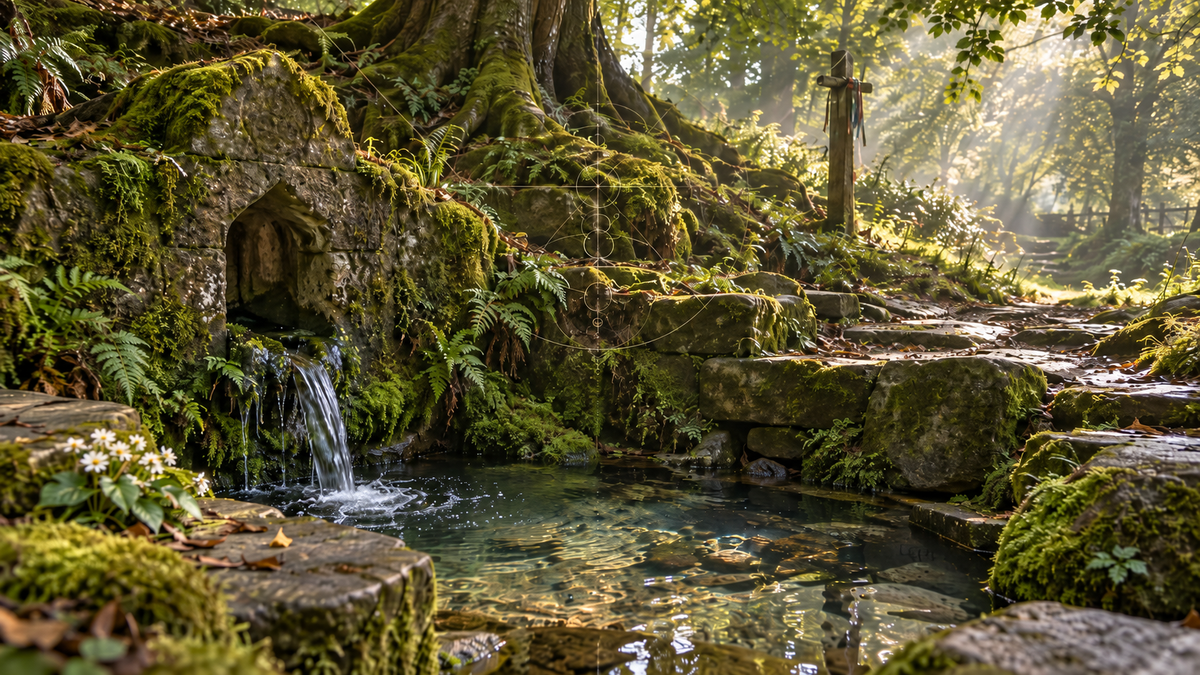
Sometimes it is just a bend in a path, a particular tree, a clearing, a hilltop or a point beside water.
In modern Earth-energy traditions, places like these are sometimes described as energy nodes: locations where subtle lines, forces or currents are believed to meet or concentrate.
There is no scientifically accepted test that can identify an energy node as a distinct physical phenomenon.
But there are places with unusual geology, deep ritual histories, striking landscape positions and strong cultural meaning. There are also many people who report powerful experiences at them.
So the useful question is not simply: “Is this place an energy node?”
A better one is: “What is happening here, what do people believe is happening here, and what can I actually observe for myself?”
What is an energy node?
Within modern ley-line and Earth-grid traditions, an energy node is usually described as a point where several energetic pathways meet.
You can think of it as the energetic equivalent of a crossroads.
In some spiritual systems, nodes are believed to concentrate or amplify subtle energy. Sacred sites, stone circles, wells, temples and hilltops are often interpreted as having been placed at or near these points.
The language varies.
You may also hear:
- power place
- Earth node
- ley intersection
- sacred centre
- vortex point
- energy centre
These terms are often used loosely, even though they do not necessarily mean the same thing.
A node is usually imagined as an intersection.
A vortex is more often described as a spiralling or concentrated field.
A sacred site may be called either, but a place can be sacred without belonging to any Earth-energy theory at all.
That distinction matters.
Sacred site, energy node or vortex?
These ideas overlap, but it helps to keep them separate.
Sacred site
A place that has cultural, religious, historical or spiritual significance.
Its sacredness may come from ritual use, pilgrimage, myth, burial, landscape, tradition or religious belief.
Energy node
A modern spiritual interpretation of a location as a point where subtle energetic pathways intersect or concentrate.
Vortex
A place believed to contain a spiralling or intensified form of energy.
The term is especially common in contemporary spiritual tourism and places such as Sedona.
A single place may be described using all three terms.
That does not mean all three claims are equally established.
Why do some places feel powerful?
This is where the subject gets interesting.
A powerful sense of place can arise from many different factors, sometimes acting together.
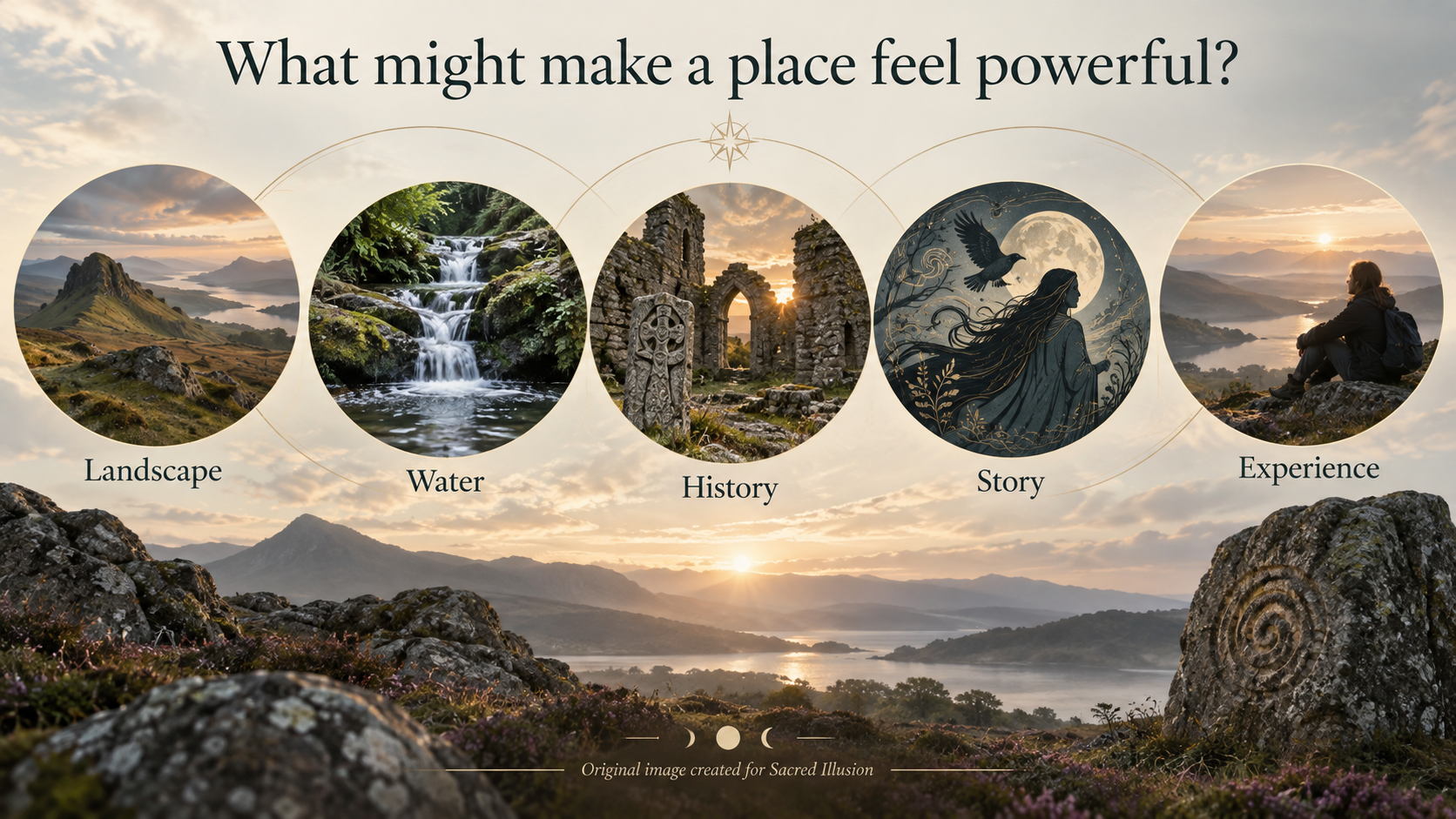
Landscape
High ground, dramatic views, caves, cliffs, enclosed valleys, springs and isolated clearings can create a strong psychological effect.
A location that changes your field of vision can also change your internal state.
Geology
Different rocks have different physical properties.
Quartz, granite, magnetite, fault zones and underground water are frequently discussed in Earth-energy literature.
These geological features are real.
What is not established is that they create a subtle spiritual field in the way practitioners sometimes claim.
Water
Springs, wells, rivers and confluences appear again and again in sacred landscapes.
Water attracts settlement, pilgrimage and ritual for obvious practical and symbolic reasons.
It also changes sound, humidity, vegetation and atmosphere.
That can make a place feel markedly different.
History
A site used for centuries for burial, worship, pilgrimage or ceremony accumulates layers of meaning.
That matters.
You do not need to assume that prayer literally charges the ground in order to acknowledge that generations of human attention can shape how a place is understood and experienced.
Architecture
Churches, temples, stone circles and ritual spaces can deliberately shape sound, sightline, movement and attention.
Some buildings are designed to make you feel small.
Others create stillness.
Some frame the sky.
Some focus the eye.
That can be profound without being supernatural.
Story
Myth changes perception.
If you know that a well is associated with healing, that a hill is linked with fairies, or that generations of pilgrims considered a site holy, you arrive differently.
Sometimes story deepens experience.
Sometimes it creates expectation.
Usually it does both.
Something else?
This is where the door stays open.
People sometimes report experiences at particular sites that they find difficult to explain through landscape, history or expectation alone.
That does not prove a subtle energy field.
It does make the experience worth recording carefully.
What do practitioners report at energy nodes?
Reports vary widely.
Some people notice physical sensations:
- tingling in the hands or feet
- warmth or cold
- pressure in the head or chest
- changes in breathing
- goosebumps
- dizziness or lightness
- a feeling of heaviness or stillness
Others describe emotional or perceptual changes:
- sudden calm
- unexpected tears
- heightened alertness
- a sense of presence
- intense familiarity
- altered sense of time
- unusually vivid dreams after visiting
- strong intuitive impressions
And some people report nothing at all.
That last category matters.
If a theory can only be confirmed by noticing something, but never challenged when nothing happens, it becomes impossible to test.
Seven things to check before calling somewhere an energy node
This is where the Sacred Illusion approach becomes practical.
1. What is physically there?
Start with the obvious.
Look at the landscape, water, rock, buildings, roads, pylons, electrical infrastructure, mobile equipment and nearby human activity.
If you notice something unusual, rule out simple explanations first.
2. What is the site's history?
Find out what actually happened there.
Was the place used for worship? Burial? Settlement? Pilgrimage? Military activity? Industry? Was the current structure built over something older?
History often explains why a site became meaningful.
It can also expose stories that turned out to be much more recent than they first appeared.
3. What claims are already attached to it?
Before visiting, note what others say.
Is it called a vortex? A ley intersection? A healing place? A portal? A pilgrimage site? A haunted location?
Write those claims down before you arrive, because expectation can shape experience.
4. What state are you in?
This sounds mundane, but it matters.
Are you tired? Hungry? Anxious? Excited? Cold? Overstimulated? Have you been walking uphill for an hour?
Your body is part of the experiment.
5. What do you actually experience?
Write down what happened before interpreting it.
For example:
Observation: “I felt tingling in my hands after five minutes.”
Interpretation: “The node activated my energy body.”
Those are not the same statement. The first is data. The second is meaning.
6. Does it repeat?
If possible, return.
Visit at a different time of day. Go in different weather. Approach from another direction. Compare your experience.
One unusual moment can be powerful, but repeated observation is much more informative.
7. What happens nearby?
This is one of the most useful tests.
If a location feels intense, spend time 100 metres away. Then 500 metres away. Then somewhere visually similar but not associated with the same story.
Comparison helps reveal whether the effect is specific to the site or part of the wider environment.
Can geology explain an energy node?
Sometimes it may explain part of the experience.
Certain geological formations can affect local magnetic readings.
Faults and underground water alter the physical structure of the ground.
Different rocks affect drainage, vegetation and landscape form.
Those things are measurable.
But moving from: “This place has unusual geology” to: “This is a spiritual energy node”
requires an additional step that science has not established.
That does not make the spiritual interpretation meaningless.
It means geology and metaphysics should not be treated as interchangeable.
Can magnetic anomalies explain unusual sensations?
Not automatically. Local magnetic variation can occur for many reasons, including rock type, buried metal, infrastructure and electrical equipment.
If you are using a compass, EMF meter or magnetometer, record what the instrument is actually measuring.
Then investigate the likely physical causes. A strange reading is interesting. It is not a spiritual diagnosis.
Can dowsing detect an energy node?
Some practitioners believe so. Dowsers may use rods or pendulums to identify intersections, boundaries or points of perceived energetic change.
If you want to experiment, make it more rigorous. Walk the area several times. Approach from different directions. Mark the point before you look at a map. Ask someone else to try without telling them where your result was.
Controlled research has not established dowsing as a reliable detector of Earth-energy structures.
But as a personal or spiritual practice, it can still form part of your field notes.
What about synchronicity?
This is one of the more interesting areas because it sits right on the edge between psychology and spiritual interpretation.
People often report synchronicities around places they regard as powerful.
Repeated numbers. Unexpected encounters. Dreams. Animals appearing at significant moments. Coincidences that seem loaded with meaning. From a psychological perspective, heightened attention makes patterns easier to notice. From a spiritual perspective, some people interpret those patterns as communication.
I believe you don't need to force a conclusion. Record the event. Record what it meant to you. Then keep the two separate.
That allows the experience to remain meaningful without pretending that meaning automatically proves mechanism.
Examples of places often described as energy nodes
Some locations recur again and again in Earth-energy traditions.
Glastonbury
Glastonbury Tor, Chalice Well and the wider landscape are frequently described as part of an energetic complex.
The area's Christian, Arthurian, pagan and modern spiritual associations all contribute to its reputation.
Avebury
Avebury's stone circle, avenues and surrounding prehistoric landscape make it one of Britain's most powerful sacred-geography locations.
Whether you see it as archaeology, ritual landscape or energy node depends upon the framework you bring.
I should say on a personal note that I have been drawn repeatedly back to Avebury. I have the privilege of working close to it and often go early and walk the stones before everyone else. There is a real presence here.
Sedona
Sedona is famous for claimed vortex locations.
Visitors frequently report strong subjective experiences there, and the vortex idea has become central to its modern spiritual identity.
Mount Shasta
Mount Shasta combines extraordinary landscape, Indigenous significance and modern esoteric traditions.
It is often described as a major planetary power point or Earth chakra in contemporary spiritual literature.
Sacred wells and springs
Many smaller energy-node traditions form around water.
A well may have local healing stories, pilgrimage history or saintly associations.
These places can be powerful precisely because they sit at the meeting point of geology, water, ritual and story.
What if a sacred place feels completely ordinary?
Then write that down. This may be one of the most important parts of fieldwork. Not every famous sacred site will move you.
Sometimes the car park is noisy. Sometimes the weather is awful. Sometimes you are tired. Sometimes nothing happens.
A place does not fail because it fails to perform. And you do not fail because you did not feel anything.
The expectation that every sacred place should produce a mystical experience can make people manufacture one.
Neutral observations are valuable.
The Sacred Illusion Node Quest method
For future Node Quests, Sacred Illusion uses five layers.
- Place - What is physically here? Landscape, geology, water, architecture, sound, sightline, weather and infrastructure.
- History - What do reliable sources tell us? Who used this place? When? For what?
- Tradition - What myths, spiritual claims, legends or esoteric interpretations are associated with it?
- Experience - What do you actually notice? Physical, emotional, intuitive or symbolic.
- Test - What could you do to challenge your first interpretation? Return. Compare. Control. Measure. Ask someone independently. Look for contradiction as well as confirmation.
That last step is important.
Curiosity becomes much more interesting when it is willing to be surprised.
Can an energy node be created?
Some spiritual traditions say yes.
Modern gridwork practitioners sometimes believe that repeated ritual, intention, prayer or sacred geometry can create or strengthen an energetic centre. There is no scientific evidence that human intention creates a measurable Earth-energy node.
But there is a grounded version of the idea that is worth taking seriously.
Human beings can absolutely create meaningful places. A memorial becomes significant because people return. A shrine becomes sacred because attention accumulates. A pilgrimage route gains power through repetition. A garden becomes a place of grief, memory or healing because of what happens there.
Perhaps some traditions describe that accumulated meaning as energy.
Whether the term is literal or metaphorical may depend on your worldview.
So, how do you recognise an energy node?
There is currently no instrument, checklist or universally accepted test that can establish that a location is an energy node.
What you can recognise is that a place has become associated with that idea.
You can investigate:
- its landscape
- geology
- water
- history
- ritual use
- cultural meaning
- reported experiences
- your own response
- whether the experience repeats
And then you can decide how far you want to take the interpretation. Some people will conclude that a place is psychologically powerful. Others will see a sacred landscape shaped by centuries of human attention. Others will experience an energetic reality that feels entirely obvious to them.
The interesting work begins when we stop demanding that every layer tell the same story.
Frequently asked questions
What is an energy node?
In modern Earth-energy traditions, an energy node is a place where subtle lines or forces are believed to intersect or concentrate. There is no scientifically accepted method for detecting such a node.
Are energy nodes the same as sacred sites?
No. A sacred site has cultural, religious or spiritual significance. An energy node is a particular spiritual interpretation of how energy may behave at a place. A site can be sacred without being described as an energy node.
What does an energy node feel like?
Practitioners report many different sensations, including calm, tingling, warmth, pressure, emotional shifts and heightened awareness. These experiences are subjective and do not identify a physical mechanism by themselves.
Can you measure an energy node?
There is no recognised scientific instrument that measures a spiritual energy node. Compasses, EMF meters and magnetometers measure specific physical phenomena and should not be treated as direct node detectors.
Can dowsing find energy nodes?
Some practitioners use dowsing rods or pendulums for this purpose, but controlled testing has not established dowsing as a reliable method for detecting Earth-energy structures.
Are vortexes and energy nodes the same thing?
Not necessarily. A node is generally described as an intersection or concentration point, while a vortex is usually described as a spiralling or rotational energy phenomenon.
Why do sacred places sometimes feel powerful?
Many factors can contribute, including landscape, architecture, geology, history, ritual use, cultural expectation and personal psychology. Spiritual traditions may interpret the same experience as evidence of subtle energy.
Continue exploring
The Earth's Energy Grid: Theories, Maps and the Search for a Hidden Network
Explore the larger theory behind ley lines, nodes, vortexes and planetary-grid models.
Earth Gridwork: A Practical Guide to Working With Sacred Landscapes
Learn how practitioners investigate and work with sacred landscapes, ley lines and claimed energy points.
What Are Ley Lines? History, Evidence and the Mystery of the Old Straight Track
Understand where ley-line theory began and how it evolved.
What Is an Energy Vortex?
Explore the next idea in the cluster: places believed to contain spiralling or concentrated energy.
Sacred Earth
Explore sacred places, pilgrimage, landscape mysteries and future Sacred Illusion Node Quests.